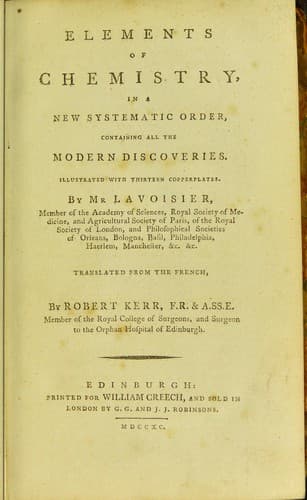
Elements of Chemistry,: In a New Systematic Order, Containing all the Modern DiscoveriesLavoisier, Antoine Laurent
Science
Elements of Chemistry,: In a New Systematic Order, Containing all the Modern Discoveries
Lavoisier, Antoine Laurent
Chemistry -- Early works to 1800
If, instead of spherical balls, we substitute solid bodies of a
hexahedral, octohedral, or any other regular figure, the capacity of the
intervals between them will be lessened, and consequently will no longer
contain the same quantity of sand. The same thing takes place, with
respect to natural bodies; the intervals left between their particles
are not of equal capacity, but vary in consequence of the different
figures and magnitude of their particles, and of the distance at which
these particles are maintained, according to the existing proportion
between their inherent attraction, and the repulsive force exerted upon
them by the caloric.
In this manner we must understand the following expression, introduced
by the English philosophers, who have given us the first precise ideas
upon this subject; _the capacity of bodies for containing the matter of
heat_. As comparisons with sensible objects are of great use in
assisting us to form distinct notions of abstract ideas, we shall
endeavour to illustrate this, by instancing the phenomena which take
place between water and bodies which are wetted and penetrated by it,
with a few reflections.
If we immerge equal pieces of different kinds of wood, suppose cubes of
one foot each, into water, the fluid gradually insinuates itself into
their pores, and the pieces of wood are augmented both in weight and
magnitude: But each species of wood will imbibe a different quantity of
water; the lighter and more porous woods will admit a larger, the
compact and closer grained will admit of a lesser quantity; for the
proportional quantities of water imbibed by the pieces will depend upon
the nature of the constituent particles of the wood, and upon the
greater or lesser affinity subsisting between them and water. Very
resinous wood, for instance, though it may be at the same time very
porous, will admit but little water. We may therefore say, that the
different kinds of wood possess different capacities for receiving
water; we may even determine, by means of the augmentation of their
weights, what quantity of water they have actually absorbed; but, as we
are ignorant how much water they contained, previous to immersion, we
cannot determine the absolute quantity they contain, after being taken
out of the water.
The same circumstances undoubtedly take place, with bodies that are
immersed in caloric; taking into consideration, however, that water is
an incompressible fluid, whereas caloric is, on the contrary, endowed
with very great elasticity; or, in other words, the particles of caloric
have a great tendency to separate from each other, when forced by any
other power to approach; this difference must of necessity occasion
very considerable diversities in the results of experiments made upon
these two substances.
Public-domain text, read in full here on John Shaqi.
Reviews
Reviews
No reviews yet
Be the first to share your thoughts on this work.
Join the Discussion
Join the discussion
Sign in to leave a comment or review.
Sign InorCreate an account