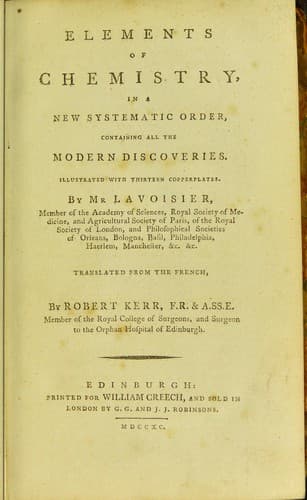
Elements of Chemistry,: In a New Systematic Order, Containing all the Modern DiscoveriesLavoisier, Antoine Laurent
Science
Elements of Chemistry,: In a New Systematic Order, Containing all the Modern Discoveries
Lavoisier, Antoine Laurent
Chemistry -- Early works to 1800
When things are thus arranged, a fire is lighted in the furnace EFCD,
which is supported of such a strength as to keep the tube EF red hot,
but not to make it melt; and, at the same time, such a fire is kept up
in the furnace VVXX, as to keep the water in the retort A continually
boiling.
In proportion as the water in the retort A is evaporated, it fills the
tube EF, and drives out the air it contained by the tube KK; the aqueous
gas formed by evaporation is condensed by cooling in the worm SS, and
falls, drop by drop, into the tubulated bottle H. Having continued this
operation until all the water be evaporated from the retort, and having
carefully emptied all the vessels employed, we find that a quantity of
water has passed over into the bottle H, exactly equal to what was
before contained in the retort A, without any disengagement of gas
whatsoever: So that this experiment turns out to be a simple
distillation; and the result would have been exactly the same, if the
water had been run from one vessel into the other, through the tube EF,
without having undergone the intermediate incandescence.
_Experiment Second._
The apparatus being disposed, as in the former experiment, 28 grs. of
charcoal, broken into moderately small parts, and which has previously
been exposed for a long time to a red heat in close vessels, are
introduced into the tube EF. Every thing else is managed as in the
preceding experiment.
The water contained in the retort A is distilled, as in the former
experiment, and, being condensed in the worm, falls into the bottle H;
but, at the same time, a considerable quantity of gas is disengaged,
which, escaping by the tube KK, is received in a convenient apparatus
for that purpose. After the operation is finished, we find nothing but a
few atoms of ashes remaining in the tube EF; the 28 grs. of charcoal
having entirely disappeared.
When the disengaged gasses are carefully examined, they are sound to
weigh 113.7 grs.[16]; these are of two kinds, viz. 144 cubical inches
of carbonic acid gas, weighing 100 grs. and 380 cubical inches of a
very light gas, weighing only 13.7 grs. which takes fire when in
contact with air, by the approach of a lighted body; and, when the water
which has passed over into the bottle H is carefully examined, it is
found to have lost 85.7 grs. of its weight. Thus, in this experiment,
85.7 grs. of water, joined to 28 grs. of charcoal, have combined in
such a way as to form 100 grs. of carbonic acid, and 13.7 grs. of a
particular gas capable of being burnt.
Public-domain text, read in full here on John Shaqi.
Reviews
Reviews
No reviews yet
Be the first to share your thoughts on this work.
Elsewhere in the archive
Join the Discussion
Join the discussion
Sign in to leave a comment or review.
Sign InorCreate an account