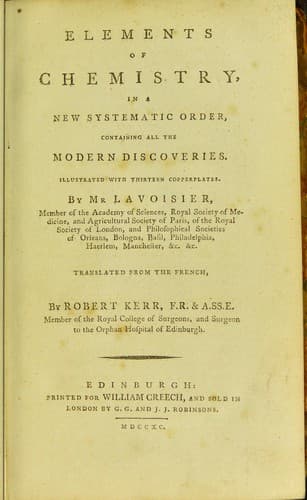
Elements of Chemistry,: In a New Systematic Order, Containing all the Modern DiscoveriesLavoisier, Antoine Laurent
Science
Elements of Chemistry,: In a New Systematic Order, Containing all the Modern Discoveries
Lavoisier, Antoine Laurent
Chemistry -- Early works to 1800
It is worthy of being examined, whether hydrogen in its concrete state,
uncombined with caloric, be susceptible of combination with sulphur,
phosphorus, and the metals. There is nothing that we know of, which, _a
priori_, should render these combinations impossible; for combustible
bodies being in general susceptible of combination with each other,
there is no evident reason for hydrogen being an exception to the rule:
However, no direct experiment as yet establishes either the possibility
or impossibility of this union. Iron and zinc are the most likely, of
all the metals, for entering into combination with hydrogen; but, as
these have the property of decomposing water, and as it is very
difficult to get entirely free from moisture in chemical experiments, it
is hardly possible to determine whether the small portions of hydrogen
gas, obtained in certain experiments with these metals, were previously
combined with the metal in the state of solid hydrogen, or if they were
produced by the decomposition of a minute quantity of water. The more
care we take to prevent the presence of water in these experiments, the
less is the quantity of hydrogen gas procured; and, when very accurate
precautions are employed, even that quantity becomes hardly sensible.
However this inquiry may turn out respecting the power of combustible
bodies, as sulphur, phosphorus, and metals, to absorb hydrogen, we are
certain that they only absorb a very small portion; and that this
combination, instead of being essential to their constitution, can only
be considered as a foreign substance, which contaminates their purity.
It is the province of the advocates[23] for this system to prove, by
decisive experiments, the real existence of this combined hydrogen,
which they have hitherto only done by conjectures founded upon
suppositions.
FOOTNOTES:
[22] This term _alloy_, which we have from the language of the arts,
serves exceedingly well for distinguishing all the combinations or
intimate unions of metals with each other, and is adopted in our new
nomenclature for that purpose.--A.
[23] By these are meant the supporters of the phlogistic theory, who at
present consider hydrogen, or the base of inflammable air, as the
phlogiston of the celebrated Stahl.--E.
CHAP. XI.
_Observations upon Oxyds and Acids with several Bases--and upon the
Composition of Animal and Vegetable Substances._
Public-domain text, read in full here on John Shaqi.
Reviews
Reviews
No reviews yet
Be the first to share your thoughts on this work.
Elsewhere in the archive
Join the Discussion
Join the discussion
Sign in to leave a comment or review.
Sign InorCreate an account