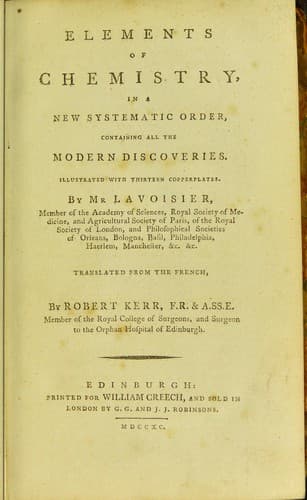
Elements of Chemistry,: In a New Systematic Order, Containing all the Modern DiscoveriesLavoisier, Antoine Laurent
Science
Elements of Chemistry,: In a New Systematic Order, Containing all the Modern Discoveries
Lavoisier, Antoine Laurent
Chemistry -- Early works to 1800
We have, in Chap. V. and VIII. examined the products resulting from the
combustion of the four simple combustible substances, sulphur,
phosphorus, charcoal, and hydrogen: We have shown, in Chap. X that the
simple combustible substances are capable of combining with each other
into compound combustible substances, and have observed that oils in
general, and particularly the fixed vegetable oils, belong to this
class, being composed of hydrogen and charcoal. It remains, in this
chapter, to treat of the oxygenation of these compound combustible
substances, and to show that there exist acids and oxyds having double
and triple bases. Nature furnishes us with numerous examples of this
kind of combinations, by means of which, chiefly, she is enabled to
produce a vast variety of compounds from a very limited number of
elements, or simple substances.
It was long ago well known, that, when muriatic and nitric acids were
mixed together, a compound acid was formed, having properties quite
distinct from those of either of the acids taken separately. This acid
was called _aqua regia_, from its most celebrated property of dissolving
gold, called _king of metals_ by the alchymists. Mr Berthollet has
distinctly proved that the peculiar properties of this acid arise from
the combined action of its two acidifiable bases; and for this reason we
have judged it necessary to distinguish it by an appropriate name: That
of _nitro-muriatic_ acid appears extremely applicable, from its
expressing the nature of the two substances which enter into its
composition.
This phenomenon of a double base in one acid, which had formerly been
observed only in the nitro-muriatic acid, occurs continually in the
vegetable kingdom, in which a simple acid, or one possessed of a single
acidifiable base, is very rarely found. Almost all the acids procurable
from this kingdom have bases composed of charcoal and hydrogen, or of
charcoal, hydrogen, and phosphorus, combined with more or less oxygen.
All these bases, whether double or triple, are likewise formed into
oxyds, having less oxygen than is necessary to give them the properties
of acids. The acids and oxyds from the animal kingdom are still more
compound, as their bases generally consist of a combination of
charcoal, phosphorus, hydrogen, and azote.
As it is but of late that I have acquired any clear and distinct notions
of these substances, I shall not, in this place, enlarge much upon the
subject, which I mean to treat of very fully in some memoirs I am
preparing to lay before the Academy. Most of my experiments are already
performed; but, to be able to give exact reports of the resulting
quantities, it is necessary that they be carefully repeated, and
increased in number: Wherefore, I shall only give a short enumeration of
the vegetable and animal acids and oxyds, and terminate this article by
a few reflections upon the composition of vegetable and animal bodies.
Public-domain text, read in full here on John Shaqi.
Reviews
Reviews
No reviews yet
Be the first to share your thoughts on this work.
Elsewhere in the archive
Join the Discussion
Join the discussion
Sign in to leave a comment or review.
Sign InorCreate an account