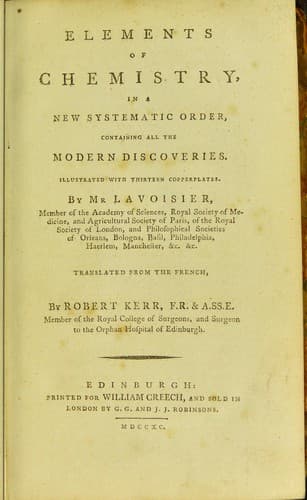
Elements of Chemistry,: In a New Systematic Order, Containing all the Modern DiscoveriesLavoisier, Antoine Laurent
Science
Elements of Chemistry,: In a New Systematic Order, Containing all the Modern Discoveries
Lavoisier, Antoine Laurent
Chemistry -- Early works to 1800
Sugar, mucus, under which term we include the different kinds of gums,
and starch, are vegetable oxyds, having hydrogen and charcoal combined,
in different proportions, as their radicals or bases, and united with
oxygen, so as to bring them to the state of oxyds. From the state of
oxyds they are capable of being changed into acids by the addition of a
fresh quantity of oxygen; and, according to the degrees of oxygenation,
and the proportion of hydrogen and charcoal in their bases, they form
the several kinds of vegetable acids.
It would be easy to apply the principles of our nomenclature to give
names to these vegetable acids and oxyds, by using the names of the two
substances which compose their bases: They would thus become
hydro-carbonous acids and oxyds: In this method we might indicate which
of their elements existed in excess, without circumlocution, after the
manner used by Mr Rouelle for naming vegetable extracts: He calls these
extracto-resinous when the extractive matter prevails in their
composition, and resino-extractive when they contain a larger proportion
of resinous matter. Upon that plan, and by varying the terminations
according to the formerly established rules of our nomenclature, we have
the following denominations: Hydro-carbonous, hydro-carbonic;
carbono-hydrous, and carbono-hydric oxyds. And for the acids:
Hydro-carbonous, hydro carbonic, oxygenated hydro-carbonic;
carbono-hydrous, carbono-hydric, and oxygenated carbono-hydric. It is
probable that the above terms would suffice for indicating all the
varieties in nature, and that, in proportion as the vegetable acids
become well understood, they will naturally arrange themselves under
these denominations. But, though we know the elements of which these are
composed, we are as yet ignorant of the proportions of these
ingredients, and are still far from being able to class them in the
above methodical manner; wherefore, we have determined to retain the
ancient names provisionally. I am somewhat farther advanced in this
inquiry than at the time of publishing our conjunct essay upon chemical
nomenclature; yet it would be improper to draw decided consequences from
experiments not yet sufficiently precise: Though I acknowledge that this
part of chemistry still remains in some degree obscure, I must express
my expectations of its being very soon elucidated.
Public-domain text, read in full here on John Shaqi.
Reviews
Reviews
No reviews yet
Be the first to share your thoughts on this work.
Elsewhere in the archive
Join the Discussion
Join the discussion
Sign in to leave a comment or review.
Sign InorCreate an account