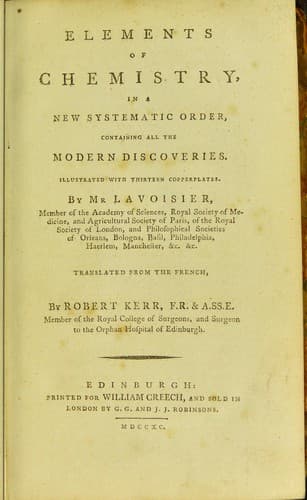
Elements of Chemistry,: In a New Systematic Order, Containing all the Modern DiscoveriesLavoisier, Antoine Laurent
Science
Elements of Chemistry,: In a New Systematic Order, Containing all the Modern Discoveries
Lavoisier, Antoine Laurent
Chemistry -- Early works to 1800
The rigorous law from which I have never deviated, of forming no
conclusions which are not fully warranted by experiment, and of never
supplying the absence of facts, has prevented me from comprehending in
this work the branch of chemistry which treats of affinities, although
it is perhaps the best calculated of any part of chemistry for being
reduced into a completely systematic body. Messrs Geoffroy, Gellert,
Bergman, Scheele, De Morveau, Kirwan, and many others, have collected a
number of particular facts upon this subject, which only wait for a
proper arrangement; but the principal data are still wanting, or, at
least, those we have are either not sufficiently defined, or not
sufficiently proved, to become the foundation upon which to build so
very important a branch of chemistry. This science of affinities, or
elective attractions, holds the same place with regard to the other
branches of chemistry, as the higher or transcendental geometry does
with respect to the simpler and elementary part; and I thought it
improper to involve those simple and plain elements, which I flatter
myself the greatest part of my readers will easily understand, in the
obscurities and difficulties which still attend that other very useful
and necessary branch of chemical science.
Perhaps a sentiment of self-love may, without my perceiving it, have
given additional force to these reflections. Mr de Morveau is at
present engaged in publishing the article _Affinity_ in the Methodical
Encyclopaedia; and I had more reasons than one to decline entering upon a
work in which he is employed.
It will, no doubt, be a matter of surprise, that in a treatise upon the
elements of chemistry, there should be no chapter on the constituent and
elementary parts of matter; but I shall take occasion, in this place, to
remark, that the fondness for reducing all the bodies in nature to three
or four elements, proceeds from a prejudice which has descended to us
from the Greek Philosophers. The notion of four elements, which, by the
variety of their proportions, compose all the known substances in
nature, is a mere hypothesis, assumed long before the first principles
of experimental philosophy or of chemistry had any existence. In those
days, without possessing facts, they framed systems; while we, who have
collected facts, seem determined to reject them, when they do not agree
with our prejudices. The authority of these fathers of human philosophy
still carry great weight, and there is reason to fear that it will even
bear hard upon generations yet to come.
Public-domain text, read in full here on John Shaqi.
Reviews
Reviews
No reviews yet
Be the first to share your thoughts on this work.
Join the Discussion
Join the discussion
Sign in to leave a comment or review.
Sign InorCreate an account