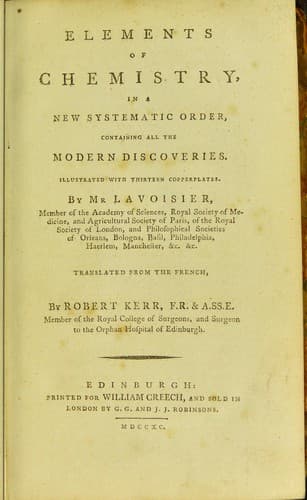
Elements of Chemistry,: In a New Systematic Order, Containing all the Modern Discoveries — John Shaqi
Elements of Chemistry,: In a New Systematic Order, Containing all the Modern DiscoveriesLavoisier, Antoine Laurent
Science
Elements of Chemistry,: In a New Systematic Order, Containing all the Modern Discoveries
Lavoisier, Antoine Laurent
Chemistry -- Early works to 1800
It is very remarkable, that, notwithstanding of the number of
philosophical chemists who have supported the doctrine of the four
elements, there is not one who has not been led by the evidence of facts
to admit a greater number of elements into their theory. The first
chemists that wrote after the revival of letters, considered sulphur and
salt as elementary substances entering into the composition of a great
number of substances; hence, instead of four, they admitted the
existence of six elements. Beccher assumes the existence of three kinds
of earth, from the combination of which, in different proportions, he
supposed all the varieties of metallic substances to be produced. Stahl
gave a new modification to this system; and succeeding chemists have
taken the liberty to make or to imagine changes and additions of a
similar nature. All these chemists were carried along by the influence
of the genius of the age in which they lived, which contented itself
with assertions without proofs; or, at least, often admitted as proofs
the slighted degrees of probability, unsupported by that strictly
rigorous analysis required by modern philosophy.
All that can be said upon the number and nature of elements is, in my
opinion, confined to discussions entirely of a metaphysical nature. The
subject only furnishes us with indefinite problems, which may be solved
in a thousand different ways, not one of which, in all probability, is
consistent with nature. I shall therefore only add upon this subject,
that if, by the term _elements_, we mean to express those simple and
indivisible atoms of which matter is composed, it is extremely probable
we know nothing at all about them; but, if we apply the term _elements_,
or _principles of bodies_, to express our idea of the last point which
analysis is capable of reaching, we must admit, as elements, all the
substances into which we are capable, by any means, to reduce bodies by
decomposition. Not that we are entitled to affirm, that these substances
we consider as simple may not be compounded of two, or even of a greater
number of principles; but, since these principles cannot be separated,
or rather since we have not hitherto discovered the means of separating
them, they act with regard to us as simple substances, and we ought
never to suppose them compounded until experiment and observation has
proved them to be so.
Public-domain text, read in full here on John Shaqi.
Reviews
Reviews
No reviews yet
Be the first to share your thoughts on this work.
Join the Discussion
Join the discussion
Sign in to leave a comment or review.
Sign InorCreate an account