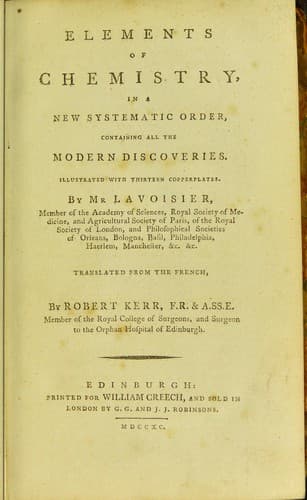
Elements of Chemistry,: In a New Systematic Order, Containing all the Modern DiscoveriesLavoisier, Antoine Laurent
Science
Elements of Chemistry,: In a New Systematic Order, Containing all the Modern Discoveries
Lavoisier, Antoine Laurent
Chemistry -- Early works to 1800
I am still more forcibly necessitated to follow the same plan in naming
the acids, which have three or four elements combined in their bases; of
these we have a considerable number from the animal kingdom, and some
even from vegetable substances. Azote, for instance, joined to hydrogen
and charcoal, form the base or radical of the Prussic acid; we have
reason to believe that the same happens with the base of the Gallic
acid; and almost all the animal acids have their bases composed of
azote, phosphorus, hydrogen, and charcoal. Were we to endeavour to
express at once all these four component parts of the bases, our
nomenclature would undoubtedly be methodical; it would have the property
of being clear and determinate; but this assemblage of Greek and Latin
substantives and adjectives, which are not yet universally admitted by
chemists, would have the appearance of a barbarous language, difficult
both to pronounce and to be remembered. Besides, this part of chemistry
being still far from that accuracy it must arrive to, the perfection of
the science ought certainly to precede that of its language; and we must
still, for some time, retain the old names for the animal oxyds and
acids. We have only ventured to make a few slight modifications of these
names, by changing the termination into _ous_, when we have reason to
suppose the base to be in excess, and into _ic_, when we suspect the
oxygen predominates.
The following are all the vegetable acids hitherto known:
1. Acetous acid.
2. Acetic acid.
3. Oxalic acid.
4. Tartarous acid.
5. Pyro-tartarous acid.
6. Citric acid.
7. Malic acid.
8. Pyro-mucous acid.
9. Pyro-lignous acid.
10. Gallic acid.
11. Benzoic acid.
12. Camphoric acid.
13. Succinic acid.
Though all these acids, as has been already said, are chiefly, and
almost entirely, composed of hydrogen, charcoal, and oxygen, yet,
properly speaking, they contain neither water carbonic acid nor oil, but
only the elements necessary for forming these substances. The power of
affinity reciprocally exerted by the hydrogen, charcoal, and oxygen, in
these acids, is in a state of equilibrium only capable of existing in
the ordinary temperature of the atmosphere; for, when they are heated
but a very little above the temperature of boiling water, this
equilibrium is destroyed, part of the oxygen and hydrogen unite, and
form water; part of the charcoal and hydrogen combine into oil; part of
the charcoal and oxygen unite to form carbonic acid; and, lastly, there
generally remains a small portion of charcoal, which, being in excess
with respect to the other ingredients, is left free. I mean to explain
this subject somewhat farther in the succeeding chapter.
Public-domain text, read in full here on John Shaqi.
Reviews
Reviews
No reviews yet
Be the first to share your thoughts on this work.
Elsewhere in the archive
Join the Discussion
Join the discussion
Sign in to leave a comment or review.
Sign InorCreate an account