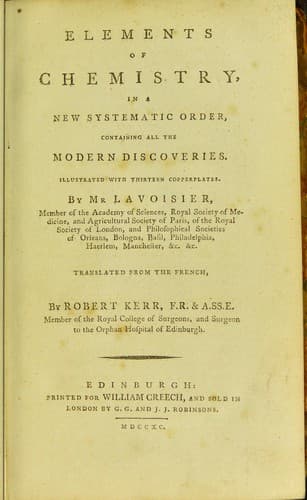
Elements of Chemistry,: In a New Systematic Order, Containing all the Modern DiscoveriesLavoisier, Antoine Laurent
Science
Elements of Chemistry,: In a New Systematic Order, Containing all the Modern Discoveries
Lavoisier, Antoine Laurent
Chemistry -- Early works to 1800
The oxyds of the animal kingdom are hitherto less known than those from
the vegetable kingdom, and their number is as yet not at all determined.
The red part of the blood, lymph, and most of the secretions, are true
oxyds, under which point of view it is very important to consider them.
We are only acquainted with six animal acids, several of which, it is
probable, approach very near each other in their nature, or, at least,
differ only in a scarcely sensible degree. I do not include the
phosphoric acid amongst these, because it is found in all the kingdoms
of nature. They are,
1. Lactic acid.
2. Saccholactic acid.
3. Bombic acid.
4. Formic acid.
5. Sebacic acid.
6. Prussic acid.
The connection between the constituent elements of the animal oxyds and
acids is not more permanent than in those from the vegetable kingdom, as
a small increase of temperature is sufficient to overturn it. I hope to
render this subject more distinct than has been done hitherto in the
following chapter.
CHAP. XII.
_Of the Decomposition of Vegetable and Animal Substances by the Action
of Fire._
Before we can thoroughly comprehend what takes place during the
decomposition of vegetable substances by fire, we must take into
consideration the nature of the elements which enter into their
composition, and the different affinities which the particles of these
elements exert upon each other, and the affinity which caloric possesses
with them. The true constituent elements of vegetables are hydrogen,
oxygen, and charcoal: These are common to all vegetables, and no
vegetable can exist without them: Such other substances as exist in
particular vegetables are only essential to the composition of those in
which they are found, and do not belong to vegetables in general.
Of these elements, hydrogen and oxygen have a strong tendency to unite
with caloric, and be converted into gas, whilst charcoal is a fixed
element, having but little affinity with caloric. On the other hand,
oxygen, which, in the usual temperature, tends nearly equally to unite
with hydrogen and with charcoal, has a much stronger affinity with
charcoal when at the red heat[24], and then unites with it to form
carbonic acid.
Public-domain text, read in full here on John Shaqi.
Reviews
Reviews
No reviews yet
Be the first to share your thoughts on this work.
Elsewhere in the archive
Join the Discussion
Join the discussion
Sign in to leave a comment or review.
Sign InorCreate an account