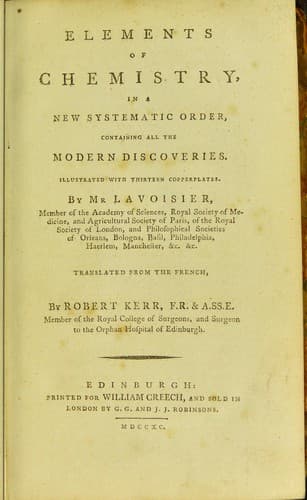
Elements of Chemistry,: In a New Systematic Order, Containing all the Modern DiscoveriesLavoisier, Antoine Laurent
Science
Elements of Chemistry,: In a New Systematic Order, Containing all the Modern Discoveries
Lavoisier, Antoine Laurent
Chemistry -- Early works to 1800
Although we are far from being able to appreciate all these powers of
affinity, or to express their proportional energy by numbers, we are
certain, that, however variable they may be when considered in relation
to the quantity of caloric with which they are combined, they are all
nearly in equilibrium in the usual temperature of the atmosphere; hence
vegetables neither contain oil[25], water, nor carbonic acid, tho' they
contain all the elements of these substances. The hydrogen is neither
combined with the oxygen nor with the charcoal, and reciprocally; the
particles of these three substances form a triple combination, which
remains in equilibrium whilst undisturbed by caloric but a very slight
increase of temperature is sufficient to overturn this structure of
combination.
If the increased temperature to which the vegetable is exposed does not
exceed the heat of boiling water, one part of the hydrogen combines with
the oxygen, and forms water, the rest of the hydrogen combines with a
part of the charcoal, and forms volatile oil, whilst the remainder of
the charcoal, being set free from its combination with the other
elements, remains fixed in the bottom of the distilling vessel.
When, on the contrary, we employ a red heat, no water is formed, or, at
least, any that may have been produced by the first application of the
heat is decomposed, the oxygen having a greater affinity with the
charcoal at this degree of heat, combines with it to form carbonic acid,
and the hydrogen being left free from combination with the other
elements, unites with caloric, and escapes in the state of hydrogen gas.
In this high temperature, either no oil is formed, or, if any was
produced during the lower temperature at the beginning of the
experiment, it is decomposed by the action of the red heat. Thus the
decomposition of vegetable matter, under a high temperature, is produced
by the action of double and triple affinities; while the charcoal
attracts the oxygen, on purpose to form carbonic acid, the caloric
attracts the hydrogen, and converts it into hydrogen gas.
The distillation of every species of vegetable substance confirms the
truth of this theory, if we can give that name to a simple relation of
facts. When sugar is submitted to distillation, so long as we only
employ a heat but a little below that of boiling water, it only loses
its water of cristallization, it still remains sugar, and retains all
its properties; but, immediately upon raising the heat only a little
above that degree, it becomes blackened, a part of the charcoal
separates from the combination, water slightly acidulated passes over
accompanied by a little oil, and the charcoal which remains in the
retort is nearly a third part of the original weight of the sugar.
Public-domain text, read in full here on John Shaqi.
Reviews
Reviews
No reviews yet
Be the first to share your thoughts on this work.
Elsewhere in the archive
Join the Discussion
Join the discussion
Sign in to leave a comment or review.
Sign InorCreate an account