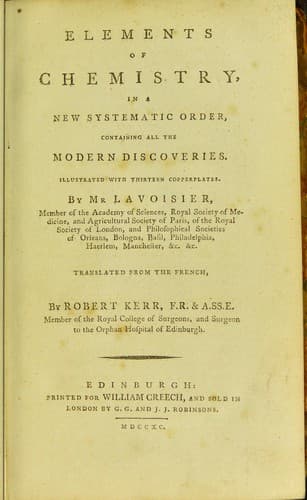
Elements of Chemistry,: In a New Systematic Order, Containing all the Modern DiscoveriesLavoisier, Antoine Laurent
Science
Elements of Chemistry,: In a New Systematic Order, Containing all the Modern Discoveries
Lavoisier, Antoine Laurent
Chemistry -- Early works to 1800
The operation of affinities which take place during the decomposition,
by fire, of vegetables which contain azote, such as the cruciferous
plants, and of those containing phosphorus, is more complicated; but, as
these substances only enter into the composition of vegetables in very
small quantities, they only, apparently, produce slight changes upon the
products of distillation; the phosphorus seems to combine with the
charcoal, and, acquiring fixity from that union, remains behind in the
retort, while the azote, combining with a part of the hydrogen, forms
ammoniac, or volatile alkali.
Animal substances, being composed nearly of the same elements with
cruciferous plants, give the same products in distillation, with this
difference, that, as they contain a greater quantity of hydrogen and
azote, they produce more oil and more ammoniac. I shall only produce one
fact as a proof of the exactness with which this theory explains all the
phenomena which occur during the distillation of animal substances,
which is the rectification and total decomposition of volatile animal
oil, commonly known by the name of Dippel's oil. When these oils are
procured by a first distillation in a naked fire they are brown, from
containing a little charcoal almost in a free state; but they become
quite colourless by rectification. Even in this state the charcoal in
their composition has so slight a connection with the other elements as
to separate by mere exposure to the air. If we put a quantity of this
animal oil, well rectified, and consequently clear, limpid, and
transparent, into a bell-glass filled with oxygen gas over mercury, in a
short time the gas is much diminished, being absorbed by the oil, the
oxygen combining with the hydrogen of the oil forms water, which sinks
to the bottom, at the same time the charcoal which was combined with the
hydrogen being set free, manifests itself by rendering the oil black.
Hence the only way of preserving these oils colourless and transparent,
is by keeping them in bottles perfectly full and accurately corked, to
hinder the contact of air, which always discolours them.
Public-domain text, read in full here on John Shaqi.
Reviews
Reviews
No reviews yet
Be the first to share your thoughts on this work.
Elsewhere in the archive
Join the Discussion
Join the discussion
Sign in to leave a comment or review.
Sign InorCreate an account