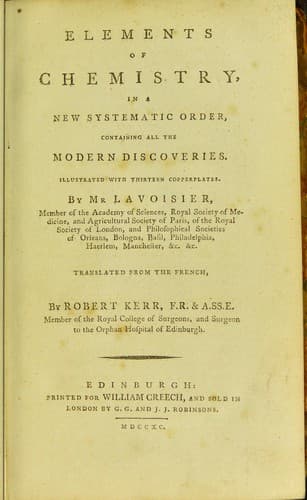
Elements of Chemistry,: In a New Systematic Order, Containing all the Modern DiscoveriesLavoisier, Antoine Laurent
Science
Elements of Chemistry,: In a New Systematic Order, Containing all the Modern Discoveries
Lavoisier, Antoine Laurent
Chemistry -- Early works to 1800
Successive rectifications of this oil furnish another phenomenon
confirming our theory. In each distillation a small quantity of charcoal
remains in the retort, and a little water is formed by the union of the
oxygen contained in the air of the distilling vessels with the hydrogen
of the oil. As this takes place in each successive distillation, if we
make use of large vessels and a considerable degree of heat, we at last
decompose the whole of the oil, and change it entirely into water and
charcoal. When we use small vessels, and especially when we employ a
slow fire, or degree of heat little above that of boiling water, the
total decomposition of these oils, by repeated distillation, is greatly
more tedious, and more difficultly accomplished. I shall give a
particular detail to the Academy, in a separate memoir, of all my
experiments upon the decomposition of oil; but what I have related above
may suffice to give just ideas of the composition of animal and
vegetable substances, and of their decomposition by the action of fire.
FOOTNOTES:
[24] Though this term, red heat, does not indicate any absolutely
determinate degree of temperature, I shall use it sometimes to express a
temperature considerably above that of boiling water.--A.
[25] I must be understood here to speak of vegetables reduced to a
perfectly dry state; and, with respect to oil, I do not mean that which
is procured by expression either in the cold, or in a temperature not
exceeding that of boiling water; I only allude to the empyreumatic oil
procured by distillation with a naked fire, in a heat superior to the
temperature of boiling water; which is the only oil declared to be
produced by the operation of fire. What I have published upon this
subject in the Memoirs of the Academy for 1786 may be consulted.--A.
CHAP. XIII.
_Of the Decomposition of Vegetable Oxyds by the Vinous Fermentation._
The manner in which wine, cyder, mead, and all the liquors formed by the
spiritous fermentation, are produced, is well known to every one. The
juice of grapes or of apples being expressed, and the latter being
diluted with water, they are put into large vats, which are kept in a
temperature of at least 10 deg. (54.5 deg.) of the thermometer. A rapid
intestine motion, or fermentation, very soon takes place, numerous
globules of gas form in the liquid and burst at the surface; when the
fermentation is at its height, the quantity of gas disengaged is so
great as to make the liquor appear as if boiling violently over a fire.
When this gas is carefully gathered, it is found to be carbonic acid
perfectly pure, and free from admixture with any other species of air or
gas whatever.
Public-domain text, read in full here on John Shaqi.
Reviews
Reviews
No reviews yet
Be the first to share your thoughts on this work.
Elsewhere in the archive
Join the Discussion
Join the discussion
Sign in to leave a comment or review.
Sign InorCreate an account