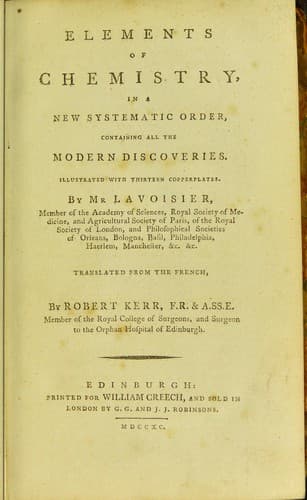
Elements of Chemistry,: In a New Systematic Order, Containing all the Modern DiscoveriesLavoisier, Antoine Laurent
Science
Elements of Chemistry,: In a New Systematic Order, Containing all the Modern Discoveries
Lavoisier, Antoine Laurent
Chemistry -- Early works to 1800
When the fermentation is completed, the juice of grapes is changed from
being sweet, and full of sugar, into a vinous liquor which no longer
contains any sugar, and from which we procure, by distillation, an
inflammable liquor, known in commerce under the name of Spirit of Wine.
As this liquor is produced by the fermentation of any saccharine matter
whatever diluted with water, it must have been contrary to the
principles of our nomenclature to call it spirit of wine rather than
spirit of cyder, or of fermented sugar; wherefore, we have adopted a
more general term, and the Arabic word _alkohol_ seems extremely proper
for the purpose.
This operation is one of the most extraordinary in chemistry: We must
examine whence proceed the disengaged carbonic acid and the inflammable
liquor produced, and in what manner a sweet vegetable oxyd becomes thus
converted into two such opposite substances, whereof one is combustible,
and the other eminently the contrary. To solve these two questions, it
is necessary to be previously acquainted with the analysis of the
fermentable substance, and of the products of the fermentation. We may
lay it down as an incontestible axiom, that, in all the operations of
art and nature, nothing is created; an equal quantity of matter exists
both before and after the experiment; the quality and quantity of the
elements remain precisely the same; and nothing takes place beyond
changes and modifications in the combination of these elements. Upon
this principle the whole art of performing chemical experiments
depends: We must always suppose an exact equality between the elements
of the body examined and those of the products of its analysis.
Public-domain text, read in full here on John Shaqi.
Reviews
Reviews
No reviews yet
Be the first to share your thoughts on this work.
Elsewhere in the archive
Join the Discussion
Join the discussion
Sign in to leave a comment or review.
Sign InorCreate an account