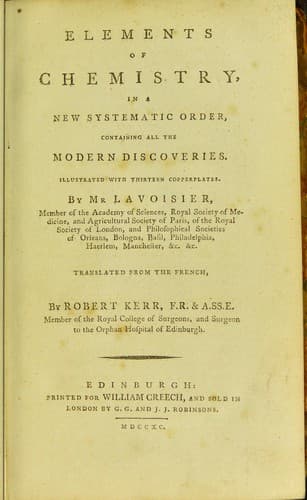
Elements of Chemistry,: In a New Systematic Order, Containing all the Modern DiscoveriesLavoisier, Antoine Laurent
Science
Elements of Chemistry,: In a New Systematic Order, Containing all the Modern Discoveries
Lavoisier, Antoine Laurent
Chemistry -- Early works to 1800
Hence, since from must of grapes we procure alkohol and carbonic acid, I
have an undoubted right to suppose that must consists of carbonic acid
and alkohol. From these premises, we have two methods of ascertaining
what passes during vinous fermentation, by determining the nature of,
and the elements which compose, the fermentable substances, or by
accurately examining the produces resulting from fermentation; and it is
evident that the knowledge of either of these must lead to accurate
conclusions concerning the nature and composition of the other. From
these considerations, it became necessary accurately to determine the
constituent elements of the fermentable substances; and, for this
purpose, I did not make use of the compound juices of fruits, the
rigorous analysis of which is perhaps impossible, but made choice of
sugar, which is easily analysed, and the nature of which I have already
explained. This substance is a true vegetable oxyd with two bases,
composed of hydrogen and charcoal brought to the state of an oxyd, by a
certain proportion of oxygen; and these three elements are combined in
such a way, that a very slight force is sufficient to destroy the
equilibrium of their connection. By a long train of experiments, made
in various ways, and often repeated, I ascertained that the proportion
in which these ingredients exist in sugar, are nearly eight parts of
hydrogen, 64 parts of oxygen, and 28 parts of charcoal, all by weight,
forming 100 parts of sugar.
Sugar must be mixed with about four times its weight of water, to render
it susceptible of fermentation; and even then the equilibrium of its
elements would remain undisturbed, without the assistance of some
substance, to give a commencement to the fermentation. This is
accomplished by means of a little yeast from beer; and, when the
fermentation is once excited, it continues of itself until completed. I
shall, in another place, give an account of the effects of yeast, and
other ferments, upon fermentable substances. I have usually employed 10
libs. of yeast, in the state of paste, for each 100 libs. of sugar,
with as much water as is four times the weight of the sugar. I shall
give the results of my experiments exactly as they were obtained,
preserving even the fractions produced by calculation.
TABLE I. _Materials of Fermentation._
libs. oz. gros grs.
Water 400 0 0 0
Sugar 100 0 0 0
Yeast in paste, 10 libs. { Water 7 3 6 44
composed of { Dry yeast 2 12 1 28
----------------------
Total 510
TABLE II. _Constituent Elements of the Materials of Fermentation._
libs. oz. gros grs.
Public-domain text, read in full here on John Shaqi.
Reviews
Reviews
No reviews yet
Be the first to share your thoughts on this work.
Elsewhere in the archive
Join the Discussion
Join the discussion
Sign in to leave a comment or review.
Sign InorCreate an account