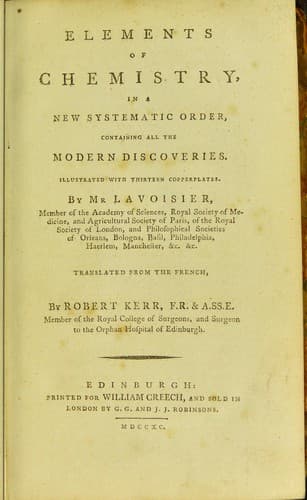
Elements of Chemistry,: In a New Systematic Order, Containing all the Modern DiscoveriesLavoisier, Antoine Laurent
Science
Elements of Chemistry,: In a New Systematic Order, Containing all the Modern Discoveries
Lavoisier, Antoine Laurent
Chemistry -- Early works to 1800
In these results, I have been exact, even to grains; not that it is
possible, in experiments of this nature, to carry our accuracy so far,
but as the experiments were made only with a few pounds of sugar, and
as, for the sake of comparison, I reduced the results of the actual
experiments to the quintal or imaginary hundred pounds, I thought it
necessary to leave the fractional parts precisely as produced by
calculation.
When we consider the results presented by these tables with attention,
it is easy to discover exactly what occurs during fermentation. In the
first place, out of the 100 libs. of sugar employed, 4 libs. 1 oz.
4 gros 3 grs. remain, without having suffered decomposition; so
that, in reality, we have only operated upon 95 libs. 14 oz. 3
gros 69 grs. of sugar; that is to say, upon 61 libs. 6 oz. 45
grs. of oxygen, 7 libs. 10 oz. 6 gros 6 grs. of hydrogen, and
26 libs. 13 oz. 5 gros 19 grs. of charcoal. By comparing these
quantities, we find that they are fully sufficient for forming the whole
of the alkohol, carbonic acid and acetous acid produced by the
fermentation. It is not, therefore, necessary to suppose that any water
has been decomposed during the experiment, unless it be pretended that
the oxygen and hydrogen exist in the sugar in that state. On the
contrary, I have already made it evident that hydrogen, oxygen and
charcoal, the three constituent elements of vegetables, remain in a
state of equilibrium or mutual union with each other which subsists so
long as this union remains undisturbed by increased temperature, or by
some new compound attraction; and that then only these elements
combine, two and two together, to form water and carbonic acid.
The effects of the vinous fermentation upon sugar is thus reduced to the
mere separation of its elements into two portions; one part is
oxygenated at the expence of the other, so as to form carbonic acid,
whilst the other part, being deoxygenated in favour of the former, is
converted into the combustible substance alkohol; therefore, if it were
possible to reunite alkohol and carbonic acid together, we ought to form
sugar. It is evident that the charcoal and hydrogen in the alkohol do
not exist in the state of oil, they are combined with a portion of
oxygen, which renders them miscible with water; wherefore these three
substances, oxygen, hydrogen, and charcoal, exist here likewise in a
species of equilibrium or reciprocal combination; and in fact, when they
are made to pass through a red hot tube of glass or porcelain, this
union or equilibrium is destroyed, the elements become combined, two and
two, and water and carbonic acid are formed.
Public-domain text, read in full here on John Shaqi.
Reviews
Reviews
No reviews yet
Be the first to share your thoughts on this work.
Elsewhere in the archive
Join the Discussion
Join the discussion
Sign in to leave a comment or review.
Sign InorCreate an account