Elements of Structural and Systematic Botany: For High Schools and Elementary College Courses — John Shaqi
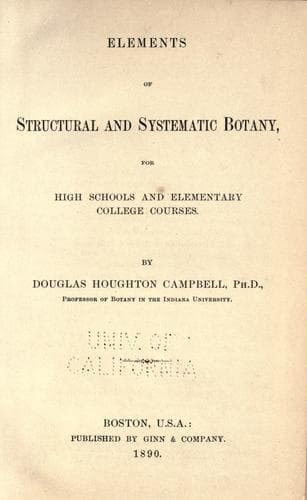
Elements of Structural and Systematic Botany: For High Schools and Elementary College CoursesCampbell, Douglas Houghton
Science
Elements of Structural and Systematic Botany: For High Schools and Elementary College Courses
Campbell, Douglas Houghton
Botany -- Textbooks
to take in solid food, are eminently animal characteristics, though
the former is common to many plants as well.
After a longer or shorter time the mass of protoplasm contracts and
gathers into little heaps, each of which develops into a structure
that has no resemblance to any animal, but would be at once placed
with plants. In one common form (_Trichia_) these are round or
pear-shaped bodies of a yellow color, and about as big as a pin head
(Fig. 5, _D_), occurring in groups on rotten logs in damp woods.
Others are stalked (_Arcyria_, _Stemonitis_) (Fig. 5, _J_, _K_), and
of various colors,--red, brown, etc. The outer part of the structure
is a more or less firm wall, which breaks when ripe, discharging a
powdery mass, mixed in most forms with very fine fibres.
When strongly magnified the fine dust is found to be made up of
innumerable small cells with thick walls, marked with ridges or
processes which differ much in different species. The fibres also
differ much in different genera. Sometimes they are simple,
hair-like threads; in others they are hollow tubes with spiral
thickenings, often very regularly placed, running around their
walls.
The spores may sometimes be made to germinate by placing them in a
drop of water, and allowing them to remain in a warm place for about
twenty-four hours. If the experiment has been successful, at the end
of this time the spore membrane will have burst, and the contents
escaped in the form of a naked mass of protoplasm (Zoöspore) with a
nucleus, and often showing a vacuole (Fig. 5, _v_), that
alternately becomes much distended, and then disappears entirely. On
first escaping it is usually provided with a long, whip-like
filament of protoplasm, which is in active movement, and by means of
which the cell swims actively through the water (Fig. 5, _I_ i).
Sometimes such a cell will be seen to divide into two, the process
taking but a short time, so that the numbers of these cells under
favorable conditions may become very large. After a time the lash is
withdrawn, and the cell assumes much the form of a small amœba (_I_
ii).
The succeeding stages are difficult to follow. After repeatedly
dividing, a large number of these amœba-like cells run together,
coalescing when they come in contact, and forming a mass of protoplasm
that grows, and finally assumes the form from which it started.
Public-domain text, read in full here on John Shaqi.
Reviews
Reviews
No reviews yet
Be the first to share your thoughts on this work.
Join the Discussion
Join the discussion
Sign in to leave a comment or review.
Sign InorCreate an account