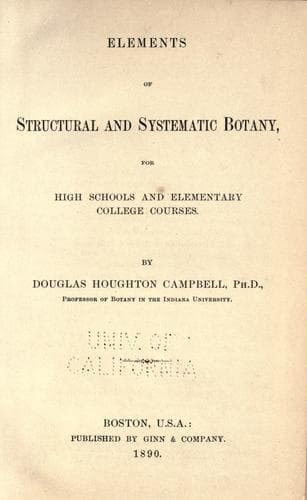
Elements of Structural and Systematic Botany: For High Schools and Elementary College CoursesCampbell, Douglas Houghton
Science
Elements of Structural and Systematic Botany: For High Schools and Elementary College Courses
Campbell, Douglas Houghton
Botany -- Textbooks
To illustrate: The white pine belongs to the highest great division
(sub-kingdom) of the plant kingdom. The plants of this division all
produce seeds, and hence are called "spermaphytes" ("seed plants").
They may be divided into two groups (classes), distinguished by
certain peculiarities in the flowers and seeds. These are named
respectively "gymnosperms" and "angiosperms," and to the first our
plant belongs. The gymnosperms may be further divided into several
subordinate groups (orders), one of which, the conifers, or
cone-bearing evergreens, includes our plant. This order includes
several families, among them the fir family (_Abietineæ_), including
the pines and firs. Of the sub-divisions (_genera_, sing. _genus_) of
the fir family, one of the most familiar is the genus _Pinus_, which
embraces all the true pines. Comparing different kinds of pines, we
find that they differ in the form of the cones, arrangement of the
leaves, and other minor particulars. The form we have selected differs
from all other native forms in its cones, and also in having the
leaves in fives, instead of twos or threes, as in most other kinds.
Therefore to distinguish the white pine from all other pines, it is
given a "specific" name, _strobus_.
The following table will show more plainly what is meant:
Sub-kingdom,
_Spermaphyta_.
/--------------------^---------------------\
Includes all spermaphytes, or seed plants.
Class,
_Gymnospermæ_.
/------------^------------\
All naked-seeded plants.
Order,
_Coniferæ_.
/--------------^--------------\
All cone-bearing evergreens.
Family,
_Abietineæ_.
/--------^--------\
Firs, Pines, etc.
Genus,
_Pinus_.
/---^---\
Pines.
Species,
_Strobus_.
/-----^-----\
White Pine.
SUB-KINGDOM I.
PROTOPHYTES.
The name Protophytes (_Protophyta_) has been applied to a large number
of simple plants, which differ a good deal among themselves. Some of
them differ strikingly from the higher plants, and resemble so
remarkably certain low forms of animal life as to be quite
indistinguishable from them, at least in certain stages. Indeed, there
are certain forms that are quite as much animal as vegetable in their
attributes, and must be regarded as connecting the two kingdoms. Such
forms are the slime moulds (Fig. 5), _Euglena_ (Fig. 9), _Volvox_
(Fig. 10), and others.
Public-domain text, read in full here on John Shaqi.
Reviews
Reviews
No reviews yet
Be the first to share your thoughts on this work.
Join the Discussion
Join the discussion
Sign in to leave a comment or review.
Sign InorCreate an account