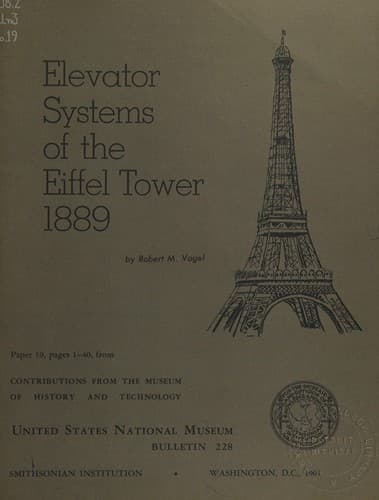
Elevator Systems of the Eiffel Tower, 1889Vogel, Robert M.
History
Elevator Systems of the Eiffel Tower, 1889
Vogel, Robert M.
Elevators -- History; Tour Eiffel (Paris, France)
Produced by Chris Curnow, Joseph Cooper and the Online
Distributed Proofreading Team at http://www.pgdp.net.
CONTRIBUTIONS FROM
THE MUSEUM OF HISTORY AND TECHNOLOGY:
PAPER 19
ELEVATOR SYSTEMS
OF THE EIFFEL TOWER, 1889
_Robert M. Vogel_
PREPARATORY WORK FOR THE TOWER 4
THE TOWER'S STRUCTURAL RATIONALE 5
ELEVATOR DEVELOPMENT BEFORE THE TOWER 6
THE TOWER'S ELEVATORS 20
EPILOGUE 37
ELEVATOR SYSTEMS of the EIFFEL TOWER, 1889
By Robert M. Vogel
_This article traces the evolution of the powered passenger elevator
from its initial development in the mid-19th century to the
installation of the three separate elevator systems in the Eiffel
Tower in 1889. The design of the Tower's elevators involved problems
of capacity, length of rise, and safety far greater than any
previously encountered in the field; and the equipment that resulted
was the first capable of meeting the conditions of vertical
transportation found in the just emerging skyscraper._
THE AUTHOR: _Robert M. Vogel is associate curator of mechanical and
civil engineering, United States National Museum, Smithsonian
Institution._
The 1,000-foot tower that formed the focal point and central feature of
the Universal Exposition of 1889 at Paris has become one of the best known
of man's works. It was among the most outstanding technological
achievements of an age which was itself remarkable for such achievements.
Second to the interest shown in the tower's structural aspects was the
interest in its mechanical organs. Of these, the most exceptional were the
three separate elevator systems by which the upper levels were made
accessible to the Exposition visitors. The design of these systems
involved problems far greater than had been encountered in previous
elevator work anywhere in the world. The basis of these difficulties was
the amplification of the two conditions that were the normal determinants
in elevator design--passenger capacity and height of rise. In addition,
there was the problem, totally new, of fitting elevator shafts to the
curvature of the Tower's legs. The study of the various solutions to these
problems presents a concise view of the capabilities of the elevator art
just prior to the beginning of the most recent phase of its development,
marked by the entry of electricity into the field.
Public-domain text, read in full here on John Shaqi.
Reviews
Reviews
No reviews yet
Be the first to share your thoughts on this work.
Join the Discussion
Join the discussion
Sign in to leave a comment or review.
Sign InorCreate an account