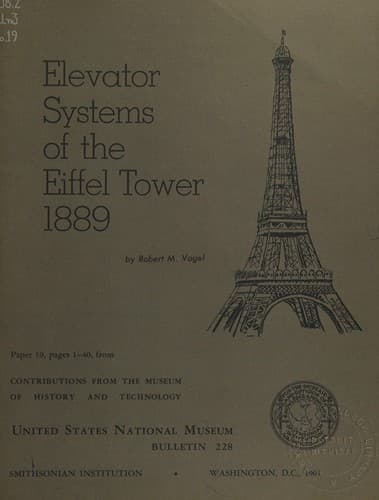
Elevator Systems of the Eiffel Tower, 1889Vogel, Robert M.
History
Elevator Systems of the Eiffel Tower, 1889
Vogel, Robert M.
Elevators -- History; Tour Eiffel (Paris, France)
By far the greatest development in this specialized branch of mechanical
engineering occurred in the United States. The comparative position of
American practice, which will be demonstrated farther on, is indicated by
the fact that Otis Brothers and other large elevator concerns in the
United States were able to establish offices in many of the major cities
of Europe and compete very successfully with local firms in spite of the
higher costs due to shipment. This also demonstrates the extent of error
in the oft-heard statement that the skyscraper was the direct result of
the elevator's invention. There is no question that continued elevator
improvement was an essential factor in the rapid increase of building
heights. However, consideration of the situation in European cities, where
buildings of over 10 stories were (and still are) rare in spite of the
availability of similar elevator techniques, points to the fundamental
matter of tradition. The European city simply did not develop with the
lack of judicial restraint which characterized metropolitan growth in the
United States. The American tendency to confine mercantile activity to the
smallest possible area resulted in excessive land values, which drove
buildings skyward. The elevator followed, or, at most, kept pace with,
the development of higher buildings.
[Illustration: Figure 14.--In the various hydraulic systems, a pump was
required if pressure from water mains was insufficient to operate the
elevator directly. There was either a gravity tank on the roof or a
pressure tank in the basement. (From Thomas E. Brown, Jr., "The American
Passenger Elevator," _Engineering Magazine_ (New York), June 1893, vol. 5,
p. 340.)]
European elevator development--notwithstanding the number of American
rope-geared hydraulic machines sold in Europe in the 10 years or so
preceding the Paris fair of 1889--was confined mainly to variations on the
direct plunger type, which was first used in English factories in the
1830's. The plunger elevator (fig. 16), an even closer derivative of the
hydraulic press than Armstrong's crane, was nothing more than a platform
on the upper end of a vertical plunger that rose from a cylinder as water
was forced in.
There were two reasons for this European practice. The first and most
apparent was the rarity of tall buildings. The drilling of a well to
receive the cylinder was thus a matter of little difficulty. This well had
to be equivalent in depth to the elevator rise. The second reason was an
innate European distrust of cable-hung elevator systems in any form, an
attitude that will be discussed more fully farther on.
THE ELECTRIC ELEVATOR
Public-domain text, read in full here on John Shaqi.
Reviews
Reviews
No reviews yet
Be the first to share your thoughts on this work.
Join the Discussion
Join the discussion
Sign in to leave a comment or review.
Sign InorCreate an account