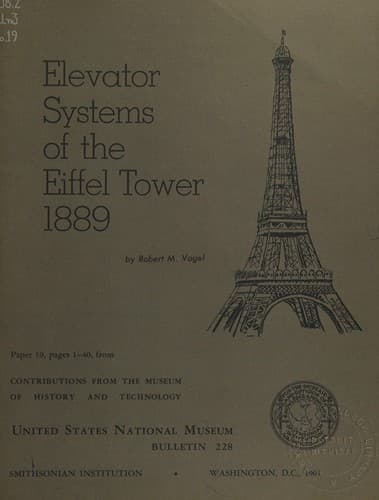
Elevator Systems of the Eiffel Tower, 1889 — John Shaqi
Elevator Systems of the Eiffel Tower, 1889Vogel, Robert M.
History
Elevator Systems of the Eiffel Tower, 1889
Vogel, Robert M.
Elevators -- History; Tour Eiffel (Paris, France)
At the time the Eiffel Tower elevators were under consideration, water
under pressure was, from a practical standpoint, the only agent capable of
fulfilling the power and control requirements of this particularly severe
service. Steam, as previously mentioned, had already been found wanting in
several respects. Electricity, on the other hand, seemed to hold promise
for almost every field of human endeavor. By 1888 the electric motor had
behind it a 10- or 15-year history of active development. Frank J. Sprague
had already placed in successful operation a sizable electric trolley-car
system, and was manufacturing motors of up to 20 horsepower in commercial
quantity. Lighting generators were being produced in sizes far greater.
There were, nevertheless, many obstacles preventing the translation of
this progress into machinery capable of hauling large groups of people a
vertical distance of 1,000 feet with unquestionable dependability.
The first application of electricity to elevator propulsion was an
experiment of the distinguished German electrician Werner von Siemens,
who, in 1880, constructed a car that successfully climbed a rack by means
of a motor and worm gearing beneath its deck (figs. 17, 18)--again, the
characteristic European distrust of cable suspension. However, the effect
of this success on subsequent development was negligible. Significant use
of electricity in this field occurred somewhat later, and in a manner
parallel to that by which steam was first applied to the elevator--the
driving of mechanical (belt driven) elevator machines by individual
motors. Slightly later came another application of the "conversion" type.
This was the simple substitution of electrically driven pumps (fig. 21)
for steam pumps in hydraulic installations. It will be recalled that pumps
were necessary in cases where water main pressure was insufficient to
operate the elevator directly.
In both of these cases the operational demands on the motor were of course
identical to those on the prime movers which they replaced; no reversal of
direction was necessary, the speed was constant, and the load was nearly
constant. Furthermore, the load could be applied to the motor gradually
through automatic relief valves on the pump and in the mechanical machines
by slippage as the belt was shifted from the loose to the fast pulleys.
The ultimate simplicity in control resulted from permitting the motor to
run continuously, drawing current only in proportion to its loading. The
direct-current motor of the 1880's was easily capable of such service, and
it was widely used in this way.
[Illustration: Figure 15.--Rope-geared hydraulic freight elevator using a
horizontal cylinder (about 1883). (From a Lane & Bodley illustrated
catalog of hydraulic elevators, Cincinnati, n.d.)]
[Illustration: Figure 16.--English direct plunger hydraulic elevator
(about 1895). (From F. Dye, _Popular Engineering_, London, 1895, p. 280.)]
Public-domain text, read in full here on John Shaqi.
Reviews
Reviews
No reviews yet
Be the first to share your thoughts on this work.
Join the Discussion
Join the discussion
Sign in to leave a comment or review.
Sign InorCreate an account