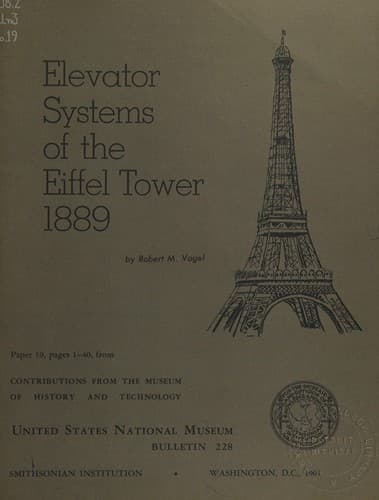
Elevator Systems of the Eiffel Tower, 1889 — John Shaqi
Elevator Systems of the Eiffel Tower, 1889Vogel, Robert M.
History
Elevator Systems of the Eiffel Tower, 1889
Vogel, Robert M.
Elevators -- History; Tour Eiffel (Paris, France)
Adaptation of the motor to the direct drive of an elevator machine was
quite another matter, the difficulties being largely those of control. At
this time the only practical means of starting a motor under load was by
introducing resistance into the circuit and cutting it out in a series of
steps as the speed picked up; precisely the method used to start traction
motors. In the early attempts to couple the motor directly to the winding
drum through worm gearing, this "notching up" was transmitted to the car
as a jerking motion, disagreeable to passengers and hard on machinery.
Furthermore, the controller contacts had a short life because of the
arcing which resulted from heavy starting currents. In all, such systems
were unsatisfactory and generally unreliable, and were held in disfavor by
both elevator experts and owners.
[Illustration: Figure 17.--Siemens' electric rack-climbing elevator of
1880. (From Werner von Siemens, _Gesammelte Abhandlungen und Vorträge_,
Berlin, 1881, pl. 5.)]
There was, moreover, little inducement to overcome the problem of control
and other minor problems because of a more serious difficulty which had
persisted since the days of steam. This was the matter of the drum and its
attendant limitations. The motor's action being rotatory, the winding drum
was the only practical way in which to apply its motive power to hoisting.
This single fact shut electricity almost completely out of any large-scale
elevator business until after the turn of the century. True, there was a
certain amount of development, after about 1887, of the electric
worm-drive drum machine for slow-speed, low-rise service (fig. 19). But
the first installation of this type that was considered practically
successful--in that it was in continuous use for a long period--was not
made until 1889,[7] the year in which the Eiffel Tower was completed.
Pertinent is the one nearly successful attempt which was made to approach
the high-rise problem electrically. In 1888, Charles R. Pratt, an elevator
engineer of Montclair, New Jersey, invented a machine based on the
horizontal cylinder rope-geared hydraulic elevator, in which the two sets
of sheaves were drawn apart by a screw and traveling nut. The screw was
revolved directly by a Sprague motor, the system being known as the
Sprague-Pratt. While a number of installations were made, the machine was
subject to several serious mechanical faults and passed out of use around
1900. Generally, electricity as a practical workable power for elevators
seemed to hold little promise in 1888.[8]
[Illustration: Figure 18.--Motor and drive mechanism of Siemens'
elevator. (From Alfred R. Urbanitzky, _Electricity in the Service of Man_,
London, 1886, p. 646.)]
[Illustration:
_Morse, Williams & Co._,
BUILDERS OF
PASSENGER
AND
FREIGHT
ELEVATORS.
ELECTRIC ELEVATOR.
Write us for Circulars and Prices.
Main Office and Works, 1105 Frankford Avenue,
PHILADELPHIA.
Public-domain text, read in full here on John Shaqi.
Reviews
Reviews
No reviews yet
Be the first to share your thoughts on this work.
Join the Discussion
Join the discussion
Sign in to leave a comment or review.
Sign InorCreate an account