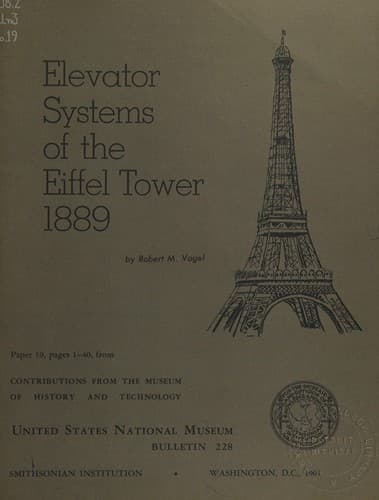
Elevator Systems of the Eiffel Tower, 1889Vogel, Robert M.
History
Elevator Systems of the Eiffel Tower, 1889
Vogel, Robert M.
Elevators -- History; Tour Eiffel (Paris, France)
Although faced with the loss not only of all previously expended design
work but also of an advertisement of international consequence, the
company apparently concurred with Hale and so advised Paris.
Unfortunately, there are no Otis records to reveal the subsequent
transactions, but we may assume that Otis' threat of withdrawal prevailed,
coupled as it was with Eiffel's confidence in the American equipment. The
system went into operation as originally designed, free of the odious rack
and pinion.
That, unfortunately, was not the final disagreement. Before the fair's
opening in May 1889, the relationship was strained so drastically that a
mutually satisfactory conclusion to the project must indeed have seemed
hopeless. The numerous minor structural modifications of the Tower legs
found necessary as construction progressed had necessitated certain
equivalent alteration to the Otis design insofar as its dependency upon
the framework was affected. Consequently, work on the machinery was set
back by some months. Eiffel was informed that although everything was
guaranteed to be in full operation by opening day on May 1, the
contractual deadline of January 1 could not possibly be met. Eiffel, now
unquestionably acting on his own volition, responded by cable, refusing
all payment. Charles Otis' reply, a classic of indignation, disclosed to
Eiffel the jeopardy in which his impetuosity had placed the success of the
entire project:
After all else we have borne and suffered and achieved in your
behalf, we regard this as a trifle too much; and we do not hesitate
to declare, in the strongest terms possible to the English language,
that we will not put up with it ... and, if there is to be War, under
the existing circumstances, propose that at least part of it shall be
fought on American ground. If Mr. Eiffel shall, on the contrary,
treat us as we believe we are entitled to be treated, under the
circumstances, and his confidence in our integrity to serve him well
shall be restored in season to admit of the completion of this work
at the time wanted, well and good; but it must be done at once ...
otherwise we shall ship no more work from this side, and Mr. Eiffel
must charge to himself the consequences of his own acts.
This message apparently had the desired effect and the matter was somehow
resolved, as the machinery was in full operation when the Exposition
opened. The installation must have had immense promotional value for Otis
Brothers, particularly in its contrast to the somewhat anomalous French
system. This contrast evidently was visible to the technically
unsophisticated as well as to visiting engineers. Several newspapers
reported that the Otis elevators were one of the best American exhibits at
the fair.
Public-domain text, read in full here on John Shaqi.
Reviews
Reviews
No reviews yet
Be the first to share your thoughts on this work.
Join the Discussion
Join the discussion
Sign in to leave a comment or review.
Sign InorCreate an account