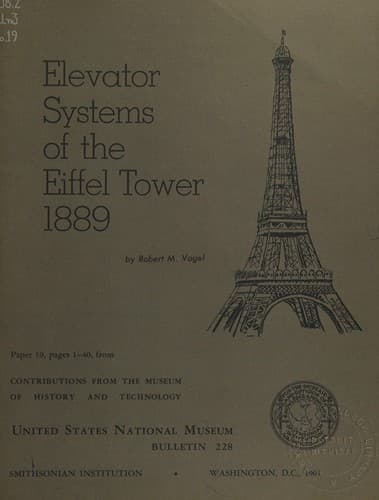
Elevator Systems of the Eiffel Tower, 1889Vogel, Robert M.
History
Elevator Systems of the Eiffel Tower, 1889
Vogel, Robert M.
Elevators -- History; Tour Eiffel (Paris, France)
In spite of their large over-all scale and the complication of the basic
pattern imposed by the unique situation, the Otis elevators performed well
and justified the original judgment and confidence which had prompted
Eiffel to fight for their installation. Aside from the obvious advantage
of simplicity when compared to the French machines, their operation was
relatively quiet, and fast.
The double car, traveling at 400 feet per minute, carried 40 persons, all
seated because of the change of inclination. The main valve or distributor
that controlled the flow of water to and from the driving cylinder was
operated from the car by cables. The hydraulic head necessary to produce
pressure within the cylinder was obtained from a large open reservoir on
the second platform. After being exhausted from the cylinder, the water
was pumped back up by two Girard pumps (fig. 31) in the engine room at
the base of the Tower's south leg.
THE SYSTEM OF ROUX, COMBALUZIER AND LEPAPE
There can be little doubt that the French elevators placed in the east and
west piers to carry visitors to the first stage of the Tower had the
important secondary function of saving face. That an engineer of Eiffel's
mechanical perception would have permitted their use, unless compelled to
do so by the Exposition Commission, is unthinkable. Whatever the attitudes
of the commissioners may have been, it must be said--recalling the
Backmann system--that they did not fear innovation. The machinery
installed by the firm of Roux, Combaluzier and Lepape was novel in every
respect, but it was a product of misguided ingenuity and set no precedent.
The system, never duplicated, was conceived, born, lived a brief and not
overly creditable life, and died, entirely within the Tower.
Basis of the French system was an endless chain of short, rigid,
articulated links (fig. 35), to one point of which the car was attached.
As the chain moved, the car was raised or lowered. Recalling the European
distrust of suspended elevators, it is interesting to note that the car
was pushed up by the links below, not drawn by those above, thus the
active links were in compression. To prevent buckling of the column, the
chain was enclosed in a conduit (fig. 36). Excessive friction was
prevented by a pair of small rollers at each of the knuckle joints between
the links. The system was, in fact, a duplicate one, with a chain on
either side of the car. At the bottom of the run the chains passed around
huge sprocket wheels, 12.80 feet in diameter, with pockets on their
peripheries to engage the joints. Smaller wheels at the top guided the
chains.
Public-domain text, read in full here on John Shaqi.
Reviews
Reviews
No reviews yet
Be the first to share your thoughts on this work.
Join the Discussion
Join the discussion
Sign in to leave a comment or review.
Sign InorCreate an account