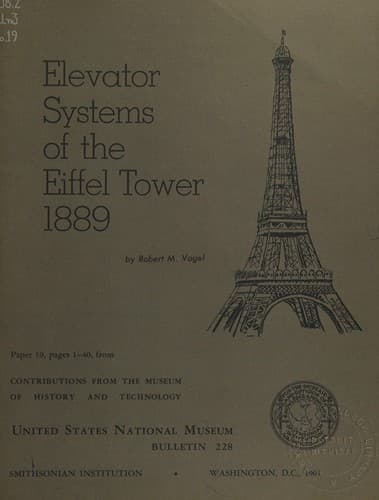
Elevator Systems of the Eiffel Tower, 1889 — John Shaqi
Elevator Systems of the Eiffel Tower, 1889Vogel, Robert M.
History
Elevator Systems of the Eiffel Tower, 1889
Vogel, Robert M.
Elevators -- History; Tour Eiffel (Paris, France)
The Fives-Lilles equipment reflected the advance of European elevator
engineering in this short time. The machines were rope-geared and
incorporated the elegant feature of self-leveling cabins which compensated
for the varying track inclination. For the 1900 fair, the Otis elevator in
the south pier was also removed and a wide stairway to the first platform
built in its place. In 1912, 25 years after Backmann's startling proposal
to use electricity for his system, the remaining Otis elevator was
replaced by a small electric one. This innovation was reluctantly
introduced solely for the purpose of accommodating visitors in the winter
when the hydraulic systems were shut down due to freezing weather. The
electric elevator had a short life, being removed in 1922 when the number
of winter visitors increased far beyond its capacity. However, the two
hydraulic systems were modified to operate in freezing
temperatures--presumably by the simple expedient of adding an
antifreezing chemical to the water--and operation was placed on a
year-round basis.
Today the two Fives-Lilles hydraulic systems remain in full use; and
visitors reach the Tower's summit by Edoux's elevator (fig. 41), which is
all that remains of the original installation.
BALANCE OF THE THREE ELEVATOR SYSTEMS
_The Otis System_
Negative effect
Weight of cabin: 23,900 lb. × sin 78°9' (incline of upper run) 23,390 lb.
Live load: 40 persons @150 lb. = 6,000 × sin 78°9' 5,872
------ -- 29,262 lb.
Positive effect
Counterweight: 55,000 × sin 54°35' (incline of lower run)
------------------------------------------
3 (rope gear ratio) 14,940 lb.
Weight of piston and chariot: 33,060 × sin 54°35'
------------------
12 (ratio) 2,245
Power: 156 p.s.i. × 1,134 sq. in. (piston area)
----------------------------------------
12 (ratio) 14,742 31,927 lb.
Excess to overcome friction 2,665 lb.
_The Roux, Combaluzier and Lepape System_
Negative effect
Weight of cabin: 14,100 × sin 54°35' 11,500 lb.
Live load: 100 persons @150 lb. = 15,000 × sin 54°35' 12,220
------ -- 23,720 lb.
Positive effect
Counterweight: 6,600 × sin 54°35' 5,380
Power: 156 p.s.i. × 2 (pistons) × 1,341.5 sq. in. (piston area)
------------------------------------------
13 (ratio) 32,196 37,576 lb.
------ ----------
Excess to overcome friction 13,856 lb.
Public-domain text, read in full here on John Shaqi.
Reviews
Reviews
No reviews yet
Be the first to share your thoughts on this work.
Join the Discussion
Join the discussion
Sign in to leave a comment or review.
Sign InorCreate an account