Elevator Systems of the Eiffel Tower, 1889 — John Shaqi
Elevator Systems of the Eiffel Tower, 1889Vogel, Robert M.
History
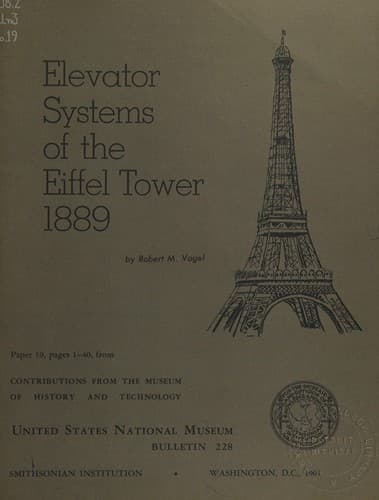
Elevator Systems of the Eiffel Tower, 1889
Vogel, Robert M.
Elevators -- History; Tour Eiffel (Paris, France)
_The Edoux System_
Negative effect
Unbalanced weight of plungers (necessary to raise full
lower car and weight of cables on lower side) 42,330 lb.
Live load: 60 persons @150 lb. 9,000
------ -- 51,330 lb.
Positive effect
Power: 227.5 p.s.i. × 2 (plungers) × 124 sq. in. (plunger area) 56,420 lb.
----------
Excess to overcome friction 5,090 lb.
Footnotes:
[1] Translated from Jean A. Keim, _La Tour Eiffel_, Paris, 1950.
[2] The foundation footings exerted a pressure on the earth of about 200
pounds per square foot, roughly one-sixth that of the Washington Monument,
then the highest structure in the world.
[3] A type of elevator known as the "teagle" was in use in some multistory
English factories by about 1835. From its description, this elevator
appears to have been primarily for the use of passengers, but it
unquestionably carried freight as well. The machine shown in figure 7 had,
with the exception of a car safety, all the features of later systems
driven from line shafting--counterweight, control from the car, and
reversal by straight and crossed belts.
[4] The Otis safety, of which a modified form is still used, consisted
essentially of a leaf wagon spring, on the car frame, kept strained by the
tension of the hoisting cables. If these gave way, the spring, released,
drove dogs into continuous racks on the vertical guides, holding the car
or platform in place.
[5] A notable exception was the elevator in the Washington Monument.
Installed in 1880 for raising materials during the structure's final
period of erection and afterwards converted to passenger service, it was
for many years the highest-rise elevator in the world (about 500 feet),
and was certainly among the slowest, having a speed of 50 feet per minute.
[6] Today, although not limited by the machinery, speeds are set at a
maximum of about 1,400 feet per minute. If higher speeds were used, an
impractically long express run would be necessary for starting and
stopping in order to prevent an acceleration so rapid as to be
uncomfortable to passengers and a strain on the equipment.
[7] Two machines, by Otis, in the Demarest Building, Fifth Avenue and 33d
Street, New York. They were in use for over 30 years.
Public-domain text, read in full here on John Shaqi.
Reviews
Reviews
No reviews yet
Be the first to share your thoughts on this work.
Join the Discussion
Join the discussion
Sign in to leave a comment or review.
Sign InorCreate an account