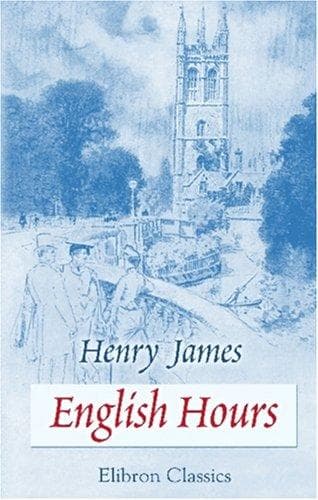
England -- Description and travel; James, Henry, 1843-1916 -- Travel -- England
that now draw out their days in the dim after-sense of a mere indulged
and encouraged picturesqueness. “Denis Duval” could only, it would
seem, have been conceived as a “picturesque” affair; but that may serve
exactly as a reason for the attempt to refigure it.
Little hilltop communities sensibly even yet, with the memory of their
tight walls and stiff gates not wholly extinct, Rye and Winchelsea
hold fast to the faint identity which remains their least fragile
support, their estate as “Antient Towns” involved (with the distincter
Five and raising the number to seven), in that nominal, though still
occasionally pompous Wardenship, the image—for our time—of the most
famous assignment of which is preserved in Longfellow’s fine verses on
the death of the Duke of Wellington. The sea, in previous times half
friend, half foe, began long since to fight, in each character, shy
of them, and now, in wrinkled wistfulness, they look across at the
straight blue band, two miles or so away, that tells of the services
they rendered, the illusions they cherished,—illusions in the case of
poor Winchelsea especially absurd,—and the extreme inconvenience they
repeatedly suffered. They were again and again harried and hacked by
the French, and might have had, it would seem, small appetite for the
company, however reduced and disarmed, of these immemorial neighbours.
The retreating waters, however, had even two centuries ago already
placed such dangers on a very different footing, and the recovery and
evocation of some of the old processes of actual absorption may well
have presented themselves to Thackeray as a problem of the sort that
tempts the lover of human histories. Happy and enviable always the
first trepidation of the artist who lights on a setting that “meets”
his subject or on a subject that meets his setting. The editorial
notes to “Denis Duval” yield unfortunately no indication of whether
Winchelsea put into his head the idea of this study, or of whether
he carried it about till he happened judiciously to drop it there.
Appearances point, in truth, to a connection of the latter kind,
for the fragment itself contains no positive evidence that Thackeray
ever, with the mere eye of sense, beheld the place; which is precisely
one of the ambiguities that challenge the critic and an item in the
unexpectedness that I spoke of at the beginning of these remarks.
What—in the light, at least, of later fashions—the place has to
offer the actual observer is the effect of an object seen, a thing of
aspect and suggestion, situation and colour; but what had it to offer
Thackeray—or the taste of forty years ago—that he so oddly forbore to
give us a tangled clew to? The impression of to-day’s reader is that
the chapters we possess might really have been written without the
author’s having stood on the spot; and that is just why they have, as I
began by saying, so much less to contribute to our personal vision than
Public-domain text, read in full here on John Shaqi.
Reviews
Reviews
No reviews yet
Be the first to share your thoughts on this work.
Elsewhere in the archive
Join the Discussion
Join the discussion
Sign in to leave a comment or review.
Sign InorCreate an account