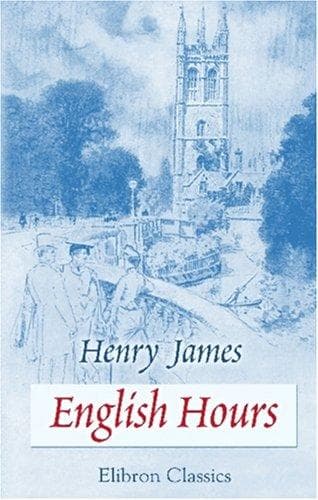
England -- Description and travel; James, Henry, 1843-1916 -- Travel -- England
[Illustration: RYE, FROM THE WINCHELSEA ROAD]
A dozen wonderments rise here, and a dozen curiosities and
speculations; as to which, in truth, I am painfully divided between the
attraction of such appeals and a certain other aspect of my subject to
which I shall attempt presently to do justice. The superior stroke, I
remind myself—possibly not in vain—would be to deal handsomely with
both solicitations. The almost irresistible fascination, critically
speaking, of the questions thus abruptly, after long years, thrust
forth by the book, lies in their having reference to this very
opposition of times and tastes. The thing is not forty years old,
but it points already—and that is above all the amusement of it—to a
general _poetic_ that, both on its positive and its negative sides,
we have left well behind. Can the author perhaps have had in mind,
misguidedly, some idea of what his public “wanted” or didn’t want? The
public is really, to a straight vision, I think, not a capacity for
wanting, at all, but only an unlimited capacity for _taking_—taking
that (whatever it is) which will, in effect, make it open its mouth.
It goes to the expense of few preconceptions, and even on the question
of opening its mouth has a consciousness limited to the suspicion that
in a given case this orifice _has_—or has not—gaped. We are therefore
to imagine Thackeray as perfectly conscious that he himself, working
by his own fine light, constituted the public he had most to reckon
with. On the other hand his time, in its degree, had helped to shape
him, and a part of the consequence of this shaping, apparently, was his
extraordinary avoidance of picture. This is the mystery that drives
us to the hypothesis of his having tried to pay, in some uncanny
quarter, some deluded deference. Was he under the fear that, even as
_he_ could do it, “description” would not, in the early sixties, be
welcome? It is impossible to stand to-day in the high, loose, sunny,
haunted square of Winchelsea without wondering what he could have been
thinking of. There are ladies in view with easels, sun-bonnets and
white umbrellas—often perceptibly, too, with nothing else that makes
for successful representation; but I doubt if it were these apparitions
that took the bloom from his vision, for they were much less frequent
in those looser days, and moreover would have formed much more a reason
for not touching the place at all than for taking it up indifferently.
Of any impulse to make the reader see it with seeing eyes his page,
at all events, gives no sign. We must presently look at it for
ourselves, even at the cost, or with the consequence, of a certain
loyal resentment. For Winchelsea is strange, individual, charming. What
_could_ he—yes—have been thinking of? We are wound up for saying that
he has given his subject away, until we suddenly remember that, to this
hour, we have never really made out what his subject was to have been.
Public-domain text, read in full here on John Shaqi.
Reviews
Reviews
No reviews yet
Be the first to share your thoughts on this work.
Elsewhere in the archive
Join the Discussion
Join the discussion
Sign in to leave a comment or review.
Sign InorCreate an account