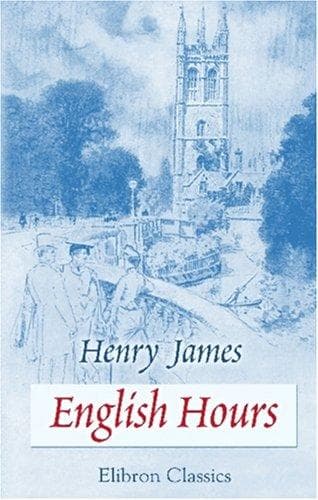
England -- Description and travel; James, Henry, 1843-1916 -- Travel -- England
If I spoke just now of Winchelsea as haunted, let this somewhat
overworked word stand as an ineffectual tribute to the small, sad,
civic history that the place appeals to us to reconstruct as we gaze
vaguely about. I have a little ancient and most decorative map of
Sussex—testifying remarkably to the changes of relation between sea
and land in this corner of the coast—in which “Old Winchelsey Drowned”
figures as the melancholy indication of a small circular spot quite
out at sea. If new Winchelsea is old, the earlier town is to-day but
the dim ghost of a tradition, with its very site—distant several miles
from that of its successor—rendered uncertain by the endless mutation
of the shore. After suffering, all through the thirteenth century, much
stress of wind and weather, it was practically destroyed in 1287 by
a great storm which cast up masses of beach, altered the course of a
river, and roughly handled the face of many things. The reconstruction
of the town in another place was thereupon decreed by a great English
king, and we need but a little fuller chronicle to help us to assist
at one of those migrations of a whole city of which antiquity so often
gives us the picture. The survivors of Winchelsea were colonised, and
colonised in much state. The “new” community, whose life was also to be
so brief, sits on the pleasant table of a great cliff-like hill which,
in the days of the Plantagenets, was an admirable promontory washed by
the waves. The sea surrounded its base, came up past it to the east and
north in a long inlet, and stretched away, across the level where the
sheep now graze, to stout little neighbouring Rye, perched—in doubtless
not quite equal pride—on an eminence more humble, but which must have
counted then even for more than to-day in the pretty figure made, as
you stand off, by the small, compact, pyramidal port. The “Antient
Towns” looked at each other then across the water, which made almost an
island of the rock of huddled, church-crowned Rye—which had too much
to say to them alike, on evil days, at their best time, but which was
too soon to begin to have too little. If the early Winchelsea was to
suffer by “drowning,” its successor was to bear the stroke of remaining
high and dry. The haven on the hill-top—a bold and extraordinary
conception—had hardly had time to get, as we should now say, “started,”
before it began to see its days numbered. The sea and the shore were
never at peace together, and it was, most remarkably, not the sea that
got the best of it. Winchelsea had only time to dream a great dream—the
dream of a scant pair of centuries—before its hopes were turned to
bitterness and its boasts to lamentation. It had literally, during its
short career, put in a claim to rivalship with the port of London. The
irony of fate now sits in its empty lap; but the port of London has
never suggested even a frustrate “Denis Duval.”
[Illustration: RYE, FROM THE MARSHES]
Public-domain text, read in full here on John Shaqi.
Reviews
Reviews
No reviews yet
Be the first to share your thoughts on this work.
Elsewhere in the archive
Join the Discussion
Join the discussion
Sign in to leave a comment or review.
Sign InorCreate an account