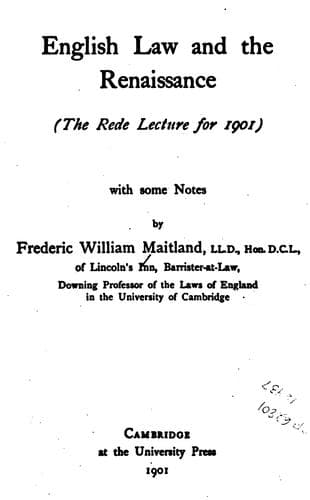
English Law and the Renaissance: The Rede Lecture for 1901Maitland, Frederic William
History
English Law and the Renaissance: The Rede Lecture for 1901
Maitland, Frederic William
Law -- England -- History; Renaissance -- England
Still the case is not yet desperate. Heroic things can be done by a
nation which means to do them: as witness the mighty effort of science
and forbearance which in our own time has unified the law of Germany,
and, having handed over the Corpus Juris to the historians, has in
some sort undone the work of the Reception[76]. Some venerable bodies
may understand the needs of the time, or, if I may borrow a famous
phrase, ‘the vocation of our age for jurisprudence and legislation.’
Our parliament may endeavour to put out work which will be a model for
the British world. It can still set an example where it can no longer
dictate, and at least it might clear away the rubbish that collects
round every body of law. To make law that is worthy of acceptance by
free communities that are not bound to accept it, this would be no mean
ambition. _Nihil aptius, nihil efficacius ad plures provincias sub uno
imperio retinendas et fovendas_[77]. But it is hardly to parliament that
our hopes must turn in the first instance. Certain ancient and honourable
societies, proud of a past that is unique in the history of the world,
may become fully conscious of the heavy weight of responsibility that was
assumed when English law schools saved, but isolated, English law in the
days of the Reception. In that case, the glory of Bourges, the glory of
Bologna, the glory of Harvard may yet be theirs[78].
NOTES.
[Sidenote: _Sir R. Rede’s lectures._]
[1] Robert Rede was Autumn Reader at Lincoln’s Inn in 1481, Lent Reader
in 1485: _Black Book of Lincoln’s Inn_, vol. 1., pp. 71, 83.
[2] Creighton, _The Early Renaissance in England_, Camb. 1895.
[3] Coke, Introductory Letter to Part 10 of the _Reports_, and Preface to
_First Institute_.
[Sidenote: _English law and the Renaissance._]
[4] Sohm, _Fränkisches Recht und römisches Recht_, 1880, p. 77: ‘…
Thatsachen in Folge deren die Renaissance an dem englischen Rechtsleben
so gut wie spurlos vorüberging.’
[Sidenote: _Sir T. More’s lectures._]
[5] Thomas More was Autumn Reader in 1511, Lent Reader in 1515: _Black
Book of Lincoln’s Inn_, vol. 1., pp. 162, 175.
[Sidenote: _The Renaissance and Roman law. Alciato and Zäsi._]
Public-domain text, read in full here on John Shaqi.
Reviews
Reviews
No reviews yet
Be the first to share your thoughts on this work.
Join the Discussion
Join the discussion
Sign in to leave a comment or review.
Sign InorCreate an account