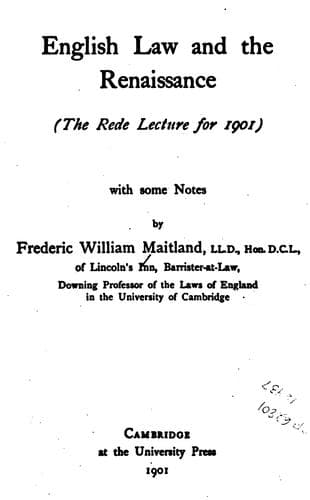
English Law and the Renaissance: The Rede Lecture for 1901Maitland, Frederic William
History
English Law and the Renaissance: The Rede Lecture for 1901
Maitland, Frederic William
Law -- England -- History; Renaissance -- England
In 1606 Coke was settling the first charter of Virginia[66]. In 1619
elected ‘burgesses’ from the various ‘hundreds’ of Virginia were
assembling, and the first-born child of the mother of parliaments saw
the light[67]. Maryland was granted to Lord Baltimore with view of
frankpledge and all that to view of frankpledge doth belong, to have and
to hold in free and common socage as of the castle of Windsor in the
county of Berks, yielding yearly therefor two Indian arrows of those
parts on the Tuesday in Easter week[68]. The port and island of Bombay
in one hemisphere[69], and in another Prince Rupert’s land stretching no
one knew how far into the frozen north were detached members of the manor
of East Greenwich in the county of Kent[70]. Nearly twenty-five hundred
copies of Blackstone’s Commentaries were absorbed by the colonies on the
Atlantic seaboard before they declared their independence. James Kent,
aged fifteen, found a copy, and (to use his own words) was inspired with
awe[71]; John Marshall found a copy in his father’s library[72]; and the
common law went straight to the Pacific[73].
A hundred legislatures--little more or less--are now building on that
foundation: on the rock that was not submerged. We will not say this
boastfully. Far from it. Standing at the beginning of a century and in
the first year of Edward VII, thinking of the wide lands which call him
king, thinking of our complex and loosely-knit British Commonwealth,
we cannot look into the future without serious misgivings. If unity of
law--such unity as there has been--disappears, much else that we treasure
will disappear also, and (to speak frankly) unity of law is precarious.
The power of the parliament of the United Kingdom to legislate for the
colonies is fast receding into the ghostly company of legal fictions.
Men of our race have been litigious; the great Ihering admired our
litigiousness[74]; it is one of our more amiable traits; but it seems to
me idle to believe that distant parts of the earth will supply a tribunal
at Westminster with enough work to secure uniformity. The so-called
common law of one colony will swerve from that of another, and both from
that of England. Some colonies will have codes[75]. If English lawyers do
not read Australian reports (and they cannot read everything), Australian
lawyers will not much longer read English reports.
Public-domain text, read in full here on John Shaqi.
Reviews
Reviews
No reviews yet
Be the first to share your thoughts on this work.
Join the Discussion
Join the discussion
Sign in to leave a comment or review.
Sign InorCreate an account