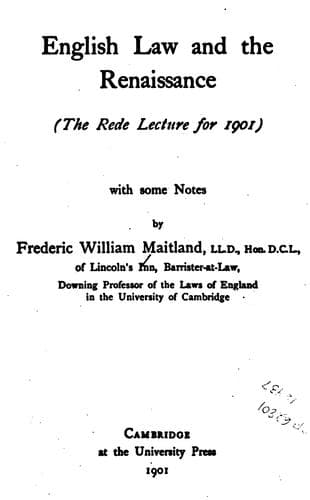
English Law and the Renaissance: The Rede Lecture for 1901Maitland, Frederic William
History
English Law and the Renaissance: The Rede Lecture for 1901
Maitland, Frederic William
Law -- England -- History; Renaissance -- England
‘Thys ys no dowte but that our law and ordur thereof ys over-confuse. Hyt
ys infynyte, and without ordur or end. Ther ys no stabyl grounde therin,
nor sure stay; but euery one that can coloure reson makyth a stope to
the best law that ys before tyme deuysyd. The suttylty of one sergeant
schal enerte [enerve?] and destroy al the jugementys of many wyse men
before tyme receyuyd. There is no stabyl ground in our commyn law to
leyne vnto. The jugementys of yerys [_i.e._ the Year Books] be infynyte
and ful of much controuersy; and, besyde that, of smal authoryte. The
jugys are not bounden, as I vnderstond, to folow them as a rule, but
aftur theyr owne lyberty they haue authoryte to juge, accordyng as they
are instructyd by the sergeantys, and as the cyrcumstance of the cause
doth them moue. And thys makyth jugementys and processe of our law to
be wythout end and infynyte; thys causyth sutys to be long in decysyon.
Therefor, to remedy thys mater groundly, hyt were necessary, in our law,
to vse the same remedy that Justynyan dyd in the law of the Romaynys,
to bryng thys infynyte processe to certayn endys, to cut away thys long
lawys, and, by the wysdome of some polytyke and wyse men, instytute a
few and bettur lawys and ordynancys. The statutys of kyngys, also, be
ouer-many, euen as the constytutyonys of the emperorys were. Wherefor I
wold wysch that al thes lawys schold be brought into some smal nombur,
and to be wryten also in our mother tong, or els put into the Latyn, to
cause them that studye the cyuyle law of our reame fyrst to begyn of the
Latyn tong, wherin they myght also afturward lerne many thyngys to helpe
thys professyon. Thys ys one thyng necessary to the educatyon of the
nobylyte, the wych only I wold schold be admyttyd to the study of thys
law. Then they myght study also the lawys of the Romaynys, where they
schold see al causys and controuersys decyded by rulys more conuenyent to
the ordur of nature then they be in thys barbarouse tong and Old French,
wych now seruyth to no purpos els. Thys, Mastur Lvpset, ys a grete blote
in our pollycy, to see al our law and commyn dyscyplyne wryten in thys
barbarouse langage, wych, aftur when the youth hath lernyd, seruyth them
to no purpos at al; and, besyde that, to say the truth, many of the lawys
themselfys be also barbarouse and tyrannycal, as you haue before hard.
[Here follows an attack on primogeniture and entail.] The wych al by thys
one remedy schold be amendyd and correct, yf we myght induce the hedys of
our cuntrey to admyt the same: that ys, to receyue the cyuyle law of the
Romaynys, the wych ys now the commyn law almost of al Chrystyan natyonys.
The wych thyng vndowtydly schold be occasyon of infynyte gudness in
the ordur of our reame, the wych I coud schow you manyfestely, but the
thyng hyt selfe ys so open and playn, that hyt nedyth no declaratyon at
al; for who ys so blynd that seth not the grete schame to our natyon,
Public-domain text, read in full here on John Shaqi.
Reviews
Reviews
No reviews yet
Be the first to share your thoughts on this work.
Join the Discussion
Join the discussion
Sign in to leave a comment or review.
Sign InorCreate an account