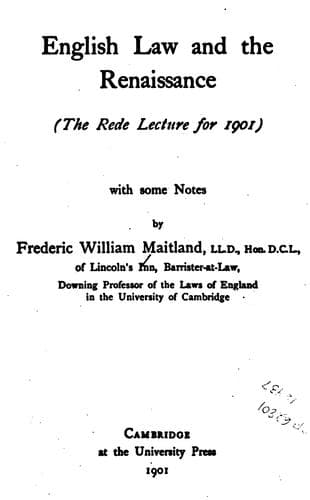
English Law and the Renaissance: The Rede Lecture for 1901 — John Shaqi
English Law and the Renaissance: The Rede Lecture for 1901Maitland, Frederic William
History
English Law and the Renaissance: The Rede Lecture for 1901
Maitland, Frederic William
Law -- England -- History; Renaissance -- England
the grete infamy and rote that remeynyth in vs, to be gouernyd by the
lawys gyuen to vs of such a barbarouse natyon as the Normannys be? Who
ys so fer from rayson that consyderyth not the tyranycal and barbarouse
instytutionys, infynyte ways left here among vs, whych al schold be wypt
away by the receyuyng of thys wych we cal the veray cyuyle law; wych ys
vndowtydly the most auncyent and nobyl monument of the Romaynys prudence
and pollycy, the wych be so wryte wyth such grauyte, that yf Nature
schold herselfe prescrybe partycular meanys wherby mankynd schold obserue
hyr lawys, I thynke sche wold admyt the same: specyally, yf they were,
by a lytyl more wysedome, brought to a lytyl bettur ordur and frame,
wych myght be sone downe and put in effect. And so ther aftur that, yf
the nobylyte were brought vp in thys lawys vndoubtydly our cuntrey wold
schortly be restoryd to as gud cyuylyte as there ys in any other natyon;
ye, and peradventure much bettur also. For though thes lawys wych I haue
so praysyd be commyn among them, yet, bycause the nobylyte ther commynly
dothe not exercyse them in the studys thereof, they be al applyd to lucur
and gayne, bycause the popular men wych are borne in pouerty only doth
exercyse them for the most parte, wych ys a grete ruyne of al gud ordur
and cyuylyte. Wherefor, Master Lvpset, yf we myght bryng thys ij. thyngys
to effecte--that ys to say, to haue the cyuyle law of the Romaynys to
be the commyn law here of Englond with vs; and, secondary, that the
nobylyte in theyr youth schold study commynly therin--I thynk we schold
not nede to seke partycular remedys for such mysordurys as we haue notyd
before; for surely thys same publyke dyscyplyne schold redresse them
lyghtly; ye, and many other mow, the wych we spake not yet of at al.’
Lupset thereupon objects that, seeing we have so many years been governed
by our own law, it will be hard to bring this reform to pass. Pole
replies that the goodness of a prince would bring it to pass quickly:
‘the wych I pray God we may onys see.’
The Pole of the Dialogue wished to make the power to entail lands a
privilege of the nobility. A project of this kind had been in the air:
perhaps in King Henry’s mind. See _Letters and Papers, Henry VIII._, vol.
IV., pt. 2, p. 2693 (A.D. 1529): ‘Draft bill … proposing to enact that
from 1 Jan. next all entails be annulled and all possessions be held in
fee simple.… The Act is not to affect the estates of noblemen within
the degree of baron.’ This is one of the proposals for restoring the
king’s feudal revenue which lead up to the Statute of Uses: an Act whose
embryonic history has not yet been written, though Dr Stubbs has thrown
out useful hints. (_Seventeen Lectures_, ed. 3, p. 321.)
Public-domain text, read in full here on John Shaqi.
Reviews
Reviews
No reviews yet
Be the first to share your thoughts on this work.
Join the Discussion
Join the discussion
Sign in to leave a comment or review.
Sign InorCreate an account