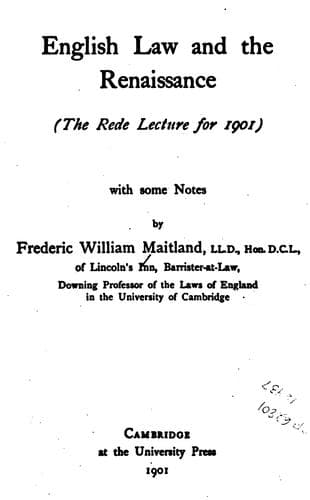
English Law and the Renaissance: The Rede Lecture for 1901 — John Shaqi
English Law and the Renaissance: The Rede Lecture for 1901Maitland, Frederic William
History
English Law and the Renaissance: The Rede Lecture for 1901
Maitland, Frederic William
Law -- England -- History; Renaissance -- England
Six years ago a great master of history, whose untimely death we are
deploring, worked the establishment of the Rede lectures into the
picture that he drew for us of The Early Renaissance in England[2]. He
brought Rede’s name into contact with the names of Fisher and More.
That, no doubt, is the right environment, and this pious founder’s care
for the humanities, for logic and for philosophy natural and moral was
a memorable sign of the times. Nevertheless the fact remains that, had
it not been for his last will and testament, we should hardly have
known Sir Robert except as an English lawyer who throve so well in his
profession that he became Chief Justice of the Common Bench. And the
rest of the acts of Robert Rede--we might say--and the arguments that he
urged and the judgments that he pronounced, are they not written in queer
old French in the Year Books of Henry VII and Henry VIII? Those ancient
law reports are not a place in which we look for humanism or the spirit
of the Renaissance: rather we look there for an amazingly continuous
persistence and development of medieval doctrine.
Perhaps we should hardly believe if we were told for the first time that
in the reign of James I a man who was the contemporary of Shakespeare
and Bacon, a very able man too and a learned, who left his mark deep
in English history, said, not by way of paradox but in sober earnest,
said repeatedly and advisedly, that a certain thoroughly medieval book
written in decadent colonial French was ‘the most perfect and absolute
work that ever was written in any human science[3].’ Yet this was what
Sir Edward Coke said of a small treatise written by Sir Thomas Littleton,
who, though he did not die until 1481, was assuredly no child of the
Renaissance.
I know that the names of Coke and Littleton when in conjunction are
fearsome names or tiresome, and in common honesty I am bound to say
that if you stay here you will be wearied. Still I feel that what is
at fault is not my theme. A lecturer worthy of that theme would--I am
sure of it--be able to convince you that there is some human interest,
and especially an interest for English-speaking mankind, in a question
which Coke’s words suggest:--How was it and why was it that in an age
when old creeds of many kinds were crumbling and all knowledge was being
transfigured, in an age which had revolted against its predecessor and
was fully conscious of the revolt, one body of doctrine and a body that
concerns us all remained so intact that Coke could promulgate this
prodigious sentence and challenge the whole world to contradict it[4]? I
have not the power to tell and you to-day have not the time to hear that
story as it should be told. A brief outline of what might be said is all
that will be possible and more than will be tolerable.
Public-domain text, read in full here on John Shaqi.
Reviews
Reviews
No reviews yet
Be the first to share your thoughts on this work.
Join the Discussion
Join the discussion
Sign in to leave a comment or review.
Sign InorCreate an account