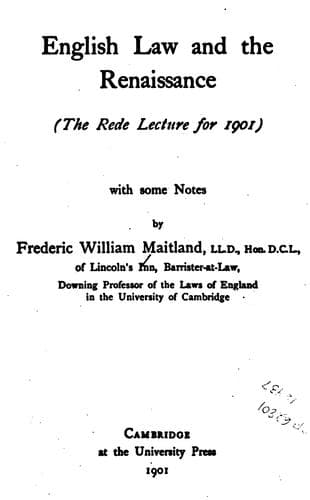
English Law and the Renaissance: The Rede Lecture for 1901 — John Shaqi
English Law and the Renaissance: The Rede Lecture for 1901Maitland, Frederic William
History
English Law and the Renaissance: The Rede Lecture for 1901
Maitland, Frederic William
Law -- England -- History; Renaissance -- England
Robert Rede died in January, 1519. Let us remember for a moment where we
stand at that date. The Emperor Maximilian also was dying. Henry VIII
was reigning in England, Francis I in France, Charles I in Spain, Leo X
at Rome. But come we to jurisprudence. Is it beneath the historic muse
to notice that young Mr More, the judge’s son, had lately lectured at
Lincoln’s Inn[5]? Perhaps so. At all events for a while we will speak of
more resonant exploits. We could hardly (so I learn at second-hand) fix a
better date than that of Rede’s death for the second new birth of Roman
law. More’s friend Erasmus had turned his back on England and was by
this time in correspondence with two accomplished jurists, the Italian
Andrea Alciato and the German Ulrich Zäsi. They and the French scholar
Guillaume Budé were publishing books which mark the beginning of a new
era[6]. Humanism was renovating Roman law. The medieval commentators, the
Balduses and Bartoluses, the people whom Hutten and Rabelais[7] could
deride, were in like case with Peter Lombard, Duns Scotus and other
men of the night. Back to the texts! was the cry, and let the light
of literature and history play upon them[8]. The great Frenchmen who
were to do the main part of the work and to make the school of Bourges
illustrious were still young or unborn; Cujas was born in 1522; but
already the advanced guard was on the march and the flourish of trumpets
might be heard[9]. And then in 1520--well, we know what happened in 1520
at Wittenberg, but perhaps we do not often remember that when the German
friar ceremoniously and contumeliously committed to the flames some
venerated law-books--this, if an event in the history of religion, was
also an event in the history of jurisprudence. A current of new life was
thrilling through one Corpus Juris[10]; the other had been sore stricken,
and, if it escaped from violent death, might perish yet more miserably of
a disease that becomes dangerous at the moment when it is discovered.
A few years afterwards an enlightened young humanist, of high rank and
marked ability, a man who might live to be pope of Rome or might live to
be king of England, was saying much evil of the sort of law that Rede
had administered and taught; was saying that a wise prince would banish
this barbaric stuff and receive in its stead the civil law of the Romans.
Such, so we learn from one of his friends, was the talk of Reginald Pole,
and a little knowledge of what was happening in foreign countries is
enough to teach us that such talk deserves attention[11].
Public-domain text, read in full here on John Shaqi.
Reviews
Reviews
No reviews yet
Be the first to share your thoughts on this work.
Join the Discussion
Join the discussion
Sign in to leave a comment or review.
Sign InorCreate an account