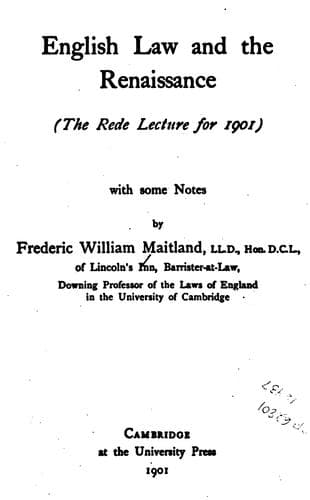
English Law and the Renaissance: The Rede Lecture for 1901Maitland, Frederic William
History
English Law and the Renaissance: The Rede Lecture for 1901
Maitland, Frederic William
Law -- England -- History; Renaissance -- England
[45] See the two papers that are printed by Waterhous, _Fortescutus
Restitutus_, 1663, pp. 539, 543. In one of these Thomas Denton, Nicholas
Bacon and Robert Cary are answering an inquiry addressed to them by Henry
VIII touching the plan of legal education pursued in the Inns of Court.
In this there are some phrases that tell of the revival of learning. The
writers thank Almighty God for giving them a king ‘endued and adorned
himself with all kindes and sortes of good learning as well divine as
prophane’ and one who ‘purposeth to set forward and as it were to revive
the study and perfect knowledge thereof [_i.e._ of good learning], of
long time detested and almost trodden under foot.’ They remark also that
many good and gentle wits have perished ‘chiefly for that most of them
in their tender years, indifferent to receive both good and bad, were so
rooted and seasoned, as it were, in barbarous authors, very enemies to
good learning, that hard it was, yea almost impossible, to reduce them to
goodness.’
The other paper contains a project for the king’s College of Law
submitted by the same three writers. This looks like an attempt to obtain
a royally endowed school of English law, and it is curious to observe
that, not English, but good French is to take the place of bad French.
‘The inner barristers shall plead in Latine, and the other barristers
reason in French; and either of them shall do what they can to banish
the corruption of both tongues.’ One learned in French is ‘to teach the
true pronuntiation of the French tongue.’ One of excellent knowledge
in the Latin and Greek tongues is to read ‘some orator or book of
rhetoric, or else some other author which treateth of the government of a
commonwealth, openly to all the company.’ Students of this college are to
be sent abroad to accompany ambassadors, and two students are to act as
historiographers of the realm. Nothing is said of the civil law. On the
whole, this seems to be a conservative proposal emanating from English
barristers for bettering the education of the common lawyer, and thus
rendering unnecessary such a Reception as Pole had proposed. We do not
know that it represents Henry’s thoughts. It was ‘a civil law college’
that Somerset wished to establish at Cambridge by a fusion of Trinity
Hall and Clare. (See Mullinger, _Hist. Univ. Camb._, vol. II., pp.
134-137.)
[Sidenote: _Butzer on Henry VIII’s project of Codification._]
Public-domain text, read in full here on John Shaqi.
Reviews
Reviews
No reviews yet
Be the first to share your thoughts on this work.
Join the Discussion
Join the discussion
Sign in to leave a comment or review.
Sign InorCreate an account