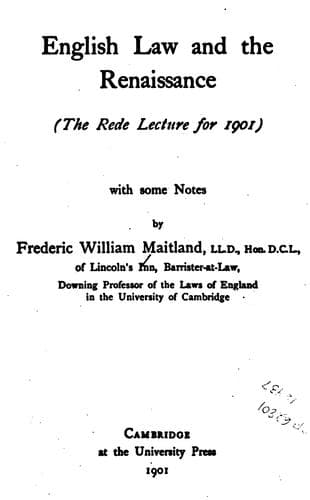
English Law and the Renaissance: The Rede Lecture for 1901Maitland, Frederic William
History
English Law and the Renaissance: The Rede Lecture for 1901
Maitland, Frederic William
Law -- England -- History; Renaissance -- England
[43] The story (with which we are familiar in England) of the evolution
of various councils and courts from an ancient _Curia Regis_ seems to
have a close parallel in French history: so close that imitation on one
side or the other may at times be suspected. After the _parlement_ with
its various chambers (which answer to our courts of common law) has
been established, the royal council interferes with judicial matters
in divers ways, and sections of the council become tribunals which
compete with the _parlement_. (See, _e.g._ Esmein, _Histoire du droit
français_, ed. 2, pp. 469 ff., and the pedigree of courts and councils
in Lavisse et Rambaud, _Histoire générale_, vol. IV., p. 143; also the
pedigree in N. Valois, _Le conseil du roi_ (1888), p. 11; and Brissaud,
_Histoire du droit français_, pp. 816 ff.) In Germany the doctors of
civil law made their way first into councils and then into courts. ‘Die
fremdrechtlich geschulten Juristen wurden in Deutschland anfänglich
nur in Verwaltungssachen verwendet. Zur Rechtsprechung gelangten sie
dadurch, dass die Verwaltung diese an sich zog, und zwar zuerst am Hofe
des Königs’ (Brunner, _Grundzüge der deutschen Rechtsgeschichte_, 1901,
p. 227). In the England of Henry VIII’s day there seems no little danger
that _die fremdrechtlich geschulten Juristen_, of whom there are a good
many in the king’s service, will gain the upper hand in the new courts
that have emerged from the council, and will proceed from _Verwaltung_ to
_Rechtsprechung_. There came a time when Dr Tunstall (who got his law at
Padua) was presiding over the Council of the North and Dr Roland Lee over
the Council of the Marches. In 1538 Dr Lee, who was endeavouring to bring
Wales to order, said in a letter to Cromwell, ‘If we should do nothing
but as the common law will, these things so far out of order will never
be redressed’ (_Dict. Nat. Biog._, vol. XXXII., p. 375).
In 1534 there was a project for the erection of yet another new court.
See _Letters and Papers, Henry VIII._, vol. VII., p. 603: ‘Draft act
of parliament for the more rigid enforcement of previous statutes,
appointing a new court, to consist of six discreet men, of whom three at
least shall be outer barristers in the Inns of Court, who shall be called
justices or conservators of the common weal and sit together in the White
Hall at Westminster or elsewhere, with power to discuss all matters
relating to the common weal and to call before them all persons who have
violated any act of parliament made since the beginning of Henry VIII.’s
reign.’ If only three of these judges need be barristers, what are the
rest to be?
[44] _Acts of the Parliament of Scotland_, vol. II., p. 335.
[Sidenote: _Reform of the Inns of Court. The king’s College of Law._]
Public-domain text, read in full here on John Shaqi.
Reviews
Reviews
No reviews yet
Be the first to share your thoughts on this work.
Join the Discussion
Join the discussion
Sign in to leave a comment or review.
Sign InorCreate an account