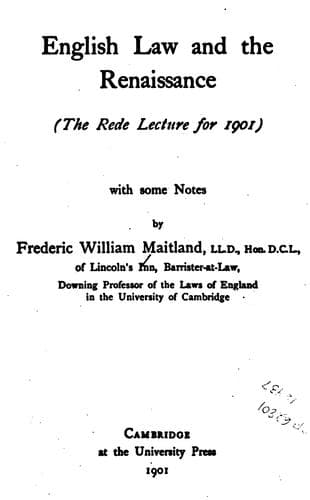
English Law and the Renaissance: The Rede Lecture for 1901Maitland, Frederic William
History
English Law and the Renaissance: The Rede Lecture for 1901
Maitland, Frederic William
Law -- England -- History; Renaissance -- England
This was the time when Roman law was driving German law out of Germany
or forcing it to conceal itself in humble forms and obscure corners[12].
If this was the age of the Renaissance and the age of the Reformation,
it was also the age of the ‘Reception.’ I need not say that this
Reception--the reception of Roman law--plays a large part in modern
versions of German history, and by no means only in such as are written
by lawyers. I need not say that it has been judged from many different
points of view, that it has been connected by some with political, by
others with religious and by yet others with economic changes. Nor need
I say that of late years few writers have had a hearty good word for the
Reception. We have all of us been nationalists of late. Cosmopolitanism
can afford to await its turn[13].
Then we observe that not long after Pole had been advocating a Reception,
his cousin King Henry, whose word was law supreme in church and state,
prohibited the academic study of one great and ancient body of law--the
canon law[14]--and encouraged the study of another--the civil law--by
the foundation of professorships at Oxford and Cambridge. We observe
also that his choice of a man to fill the chair at Cambridge fell on one
who was eminently qualified to represent in his own person that triad of
the three R’s--Renaissance, Reformation and Reception. We know Professor
Thomas Smith as a humanist, an elegant scholar with advanced opinions
about the pronunciation of Greek. We know the Reverend Thomas Smith as
a decided, if cautious, protestant whose doings are of some interest
to those who study the changeful history of ecclesiastical affairs.
Then we know Dr Thomas Smith as a doctor in law of the university of
Padua, for with praiseworthy zeal when he was appointed professor at
Cambridge he journeyed to the fountain-head for his Roman law and his
legal degree[15]. Also he visited those French universities whence a
new jurisprudence was beginning to spread. He returned to speak to
us in two inaugural lectures of this new jurisprudence: to speak
with enthusiasm of Alciatus and Zasius[16]: to speak hopefully of the
future that lay before this conquering science--the future that lay
before it in an England fortunately ruled by a pious, wise, learned and
munificent Prince. Then in Edward VI’s day Thomas Smith as a Master of
Requests was doing justice in a court whose procedure was described as
being ‘altogether according to the process of summary causes in the
civil law’ and at that moment this Court of Requests and other courts
with a like procedure seemed to have time, reason and popularity upon
their side[17]. Altogether, the Rev. Prof. Dr Sir Thomas Smith, Knt.,
M.P., Dean of Carlisle, Provost of Eton, Ambassador to the Court of
France and Secretary of State to Queen Elizabeth was a man of mark in
an age of great events. Had some of those events been other than they
were, we might now be saying of him that he played a prominent part in
Public-domain text, read in full here on John Shaqi.
Reviews
Reviews
No reviews yet
Be the first to share your thoughts on this work.
Join the Discussion
Join the discussion
Sign in to leave a comment or review.
Sign InorCreate an account