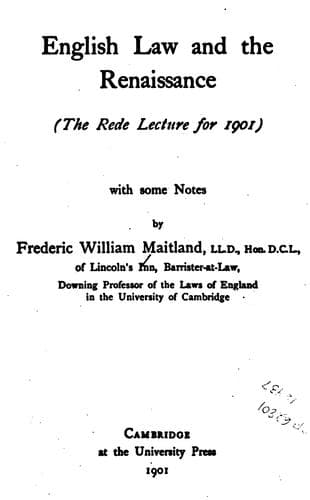
English Law and the Renaissance: The Rede Lecture for 1901Maitland, Frederic William
History
English Law and the Renaissance: The Rede Lecture for 1901
Maitland, Frederic William
Law -- England -- History; Renaissance -- England
made apon any rule certeine or lawe written.… And for a more amplyfyeng
and inlarging of the jurisdiction of the saide Courte of Chauncery and
derogacion of the saide Comen Lawes there is of late a Commission made
contrary to the saide Commen Lawes unto certaine persones, the more part
whereof be Civilians nat learned in the saide Lawes of this realme,
autorising them to heare and determyne all matters and cawses exhibited
into the saide Courte of Chauncery, by occasion whereof the matters there
do daily more and more increase, insomuch as very fewe matters be now
depending at the Comen Lawes.… And by reason thereof there hath of late
growne such a discourage unto the studentes of the saide Commen Lawes,
and the said Commen Lawes have been of late so little estemed and had in
experience, that fewe have or do regarde to take paynes of the profownde
and sincere knolege of the same Lawe, by reason whereof there ar now very
few, and it is to be doubted that within fewe yeares there shall nat be
sufficient of lerned men within this realme to serve the king in that
facultie. It therfore may please your honorable Lordships to make suche
speady reformacion in the premisses as unto your Lordships shall seem
moste mete and convenient.’
This petition led to the disgrace and punishment of the chancellor, the
Earl of Southampton (Wriothesley), for having issued a commission without
warrant and without consulting his fellow-executors of King Henry’s
will. With Somerset’s motives for thrusting Southampton aside we are
not concerned. (See Pollard, _England under the Protector Somerset_, pp.
31-33.) That he had any desire to protect the common lawyers we must not
assume; but the petition itself deserves attention. The commissioners
to whom Southampton had delegated judicial powers were Robert Southwell
(master of the rolls), John Tregonwell, John Oliver, and Anthony
Bellasyse (masters of chancery). Tregonwell, Oliver and Bellasyse were
all doctors of the civil law (_Dict. Nat. Biog._).
Public-domain text, read in full here on John Shaqi.
Reviews
Reviews
No reviews yet
Be the first to share your thoughts on this work.
Join the Discussion
Join the discussion
Sign in to leave a comment or review.
Sign InorCreate an account