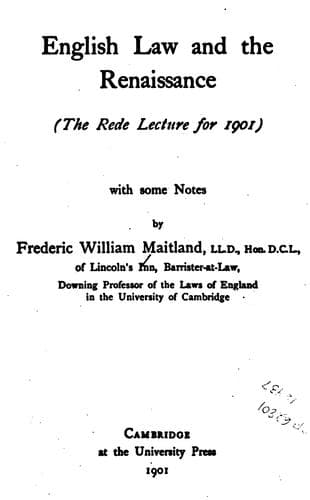
English Law and the Renaissance: The Rede Lecture for 1901Maitland, Frederic William
History
English Law and the Renaissance: The Rede Lecture for 1901
Maitland, Frederic William
Law -- England -- History; Renaissance -- England
In 1536 during the Pilgrimage of Grace one of the demands of the catholic
insurgents was ‘that the common laws may have place as was used at
the beginning of the reign and that no injunctions be granted unless
the matter has been determined in chancery.’ This comes at the end of
a long reactionary programme, which desires the restoration of the
monasteries, of the papal supremacy and so forth: also the repeal of the
statute ‘That no man shall not will his lands’ [Statute of Uses]. The
heretical bishops [Cranmer and his like] are to be burnt; Cromwell is
‘to have condign punishment.’ Also ‘a man is to be saved by his book,’
_i.e._ there is to be no infringement of the benefit of clergy. The
heresies to be suppressed are those of ‘Luther, Wyclif, Husse, Malangton,
Elicampadus [Oecolampadius], Bucerus, Confessa Germaniae [Augsburg
Confession], Apolugia Malanctons, the works of Tyndall, of Barnys, of
Marshall, Raskell [Rastell, the printer of law books], Seynt Germayne
[author of Doctor and Student] and such other heresies of Anibaptist.’
As I understand the protest against injunctions, it means that the
chancery may interfere with an action at common law, only if that action
is opening a question already decided in the chancery. It will be seen
that in 1536 the cause of ‘the common laws’ finds itself in very queer
company: illiterate, monkish and papistical company, which apparently has
made a man of ‘Anibaptist.’ (For this important manifesto, see _Letters
and Papers, Henry VIII._, vol. XI., pp. 506-507.)
[Sidenote: _Elbow-room in the courts of law._]
[52] Stow, _Annals_, ed. 1615, p. 631: ‘This yeere (1557) in Michaelmas
terme men might have seene in Westminster hall at the Kinges bench barre
not two men of law before the iustices; there was but one named Fostar,
who looked about and had nothing to doe, the iudges looking about them.
In the common place [Court of Common Pleas] no moe sergeants but one,
which was sergeant Bouloise [Bendlowes?], who looked about him, there was
elbow roome enough, which made the lawyers complaine of their iniuries
in that terme.’ In 1536 John Rastell the lawyer and printer of law books
complains to Cromwell that in both capacities he is in a bad way: he used
to print from two to three hundred reams every year but now prints not a
hundred reams in two years; he used to make forty marks a year by the law
and now does not make forty shillings (Ellis, _Original Letters_, Ser.
III., vol. II., p. 309). On such stories as these little stress is laid;
but until the judicial records of the Tudor reigns are statistically
examined, scraps of information may be useful.
[Sidenote: _Examination by civilians in criminal cases._]
[53] For an instance see the examination of a servant of the Abbot of
Sawley by Drs Layton, Legh and Petre (_Letters and Papers, Henry VIII._,
vol. XII., pt. 1, p. 231).
[Sidenote: _The doctors of law and the Peasants’ War._]
Public-domain text, read in full here on John Shaqi.
Reviews
Reviews
No reviews yet
Be the first to share your thoughts on this work.
Join the Discussion
Join the discussion
Sign in to leave a comment or review.
Sign InorCreate an account