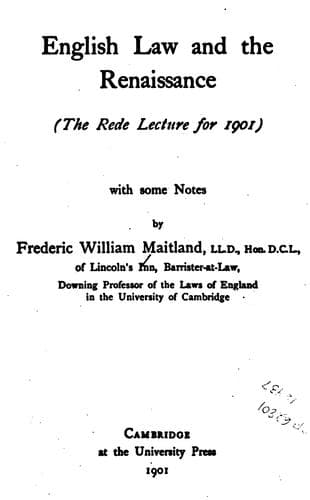
English Law and the Renaissance: The Rede Lecture for 1901Maitland, Frederic William
History
English Law and the Renaissance: The Rede Lecture for 1901
Maitland, Frederic William
Law -- England -- History; Renaissance -- England
[58] Siegel, _Deutsche Rechtsgeschichte_, ed. 3, p. 152: ‘Den ersten
und zugleich entscheidenden Schritt in dieser Richtung that Georg
Beyer, welcher… zunächst durch einen Zufall veranlasst wurde, an der
Wittenberger Universität, wohin er als Pandektist berufen worden war,
1707 eine Vorlesung über das _ius germanicum_ anzukündigen und zu halten.’
[Sidenote: _Professorships in America._]
[59] Thayer, _The Teaching of English Law at Universities_ in _Harvard
Law Review_, vol. IX., p. 171: ‘Blackstone’s example was immediately
followed here.… In 1779 … a chair of law was founded in Virginia
at William and Mary College … and in the same year Isaac Royall of
Massachusetts, then a resident in London, made his will, giving property
to Harvard College for establishing there that professorship of law which
still bears his name.’ The Royall professorship was actually founded in
1815 (_Officers and Graduates of Harvard_, 1900, p. 24). At Cambridge
(England) the Downing professorship was founded in 1800.
[Sidenote: _The Inns of Court._]
[60] See _Records of the Honorable Society of Lincoln’s Inn_, 1896 ff.;
_Calendar of the Records of the Inner Temple_, 1896. The records of
Gray’s Inn are, so I understand, to be published. See also Philip A.
Smith, _History of Education for the English Bar_, 1860; Joseph Walton,
_Early History of Legal Studies in England_, 1900, read at a meeting
of the American Bar Association in 1899. In foreign countries there
were gilds or fraternities of lawyers. Thus in Paris the _avocats_
and _procureurs_ about the middle of the fourteenth century formed a
fraternity of St Nicholas: ‘dont le chef porte le bâton ou bannière
(de là le nom de bâtonnier)’: Brissaud, _Histoire du droit français_,
p. 898. But, though a certain care for the education of apprentices
was a natural function of the medieval craft-gild, I cannot find that
elsewhere than in England fraternities of legal practitioners took upon
themselves to educate students and to give what in effect were degrees,
and degrees which admitted to practice in the courts. R. Delachenal,
_Histoire des avocats au parlement de Paris_ (Paris, 1885), says that,
though not proved, it is probable that already in the fourteenth and
fifteenth centuries the _avocat_ had to be either _licencié en lois_
or _licencié en décret_: in other words, a legal degree given by an
university was necessary for the intending practitioner. As regards the
England of the same age two interesting questions might be asked. Was
there any considerable number of doctors or bachelors of law who were not
clergymen? Had the English judge or the English barrister usually been at
an university? I am inclined to think that a negative answer should be
given to the first question and perhaps to the second also. Apparently
Littleton (to take one example) is not claimed by Oxford or Cambridge.
[Sidenote: _Sir T. Smith and the Inns of Court._]
Public-domain text, read in full here on John Shaqi.
Reviews
Reviews
No reviews yet
Be the first to share your thoughts on this work.
Join the Discussion
Join the discussion
Sign in to leave a comment or review.
Sign InorCreate an account