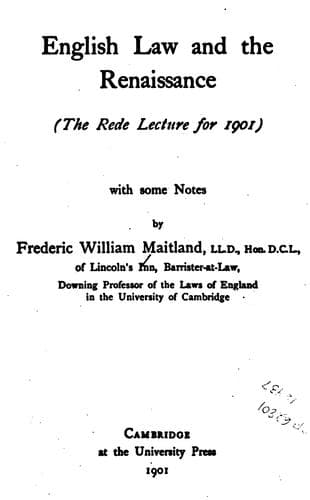
English Law and the Renaissance: The Rede Lecture for 1901Maitland, Frederic William
History
English Law and the Renaissance: The Rede Lecture for 1901
Maitland, Frederic William
Law -- England -- History; Renaissance -- England
A full history of the Reception in Scotland seems to be a desideratum.
But see Goudy, _Fate of Roman Law_ (Inaugural Lecture), 1894; also J. M.
Irvine, _Roman Law_ in _Green’s Encyclopædia of the Law of Scotland_.
Whether at any time the Reception in Scotland ran the length that it ran
in Germany may be doubted; but the influence exercised by English example
since 1603 would deserve the historian’s consideration. Even if this
influence went no further than the establishment of the habit of finding
‘authority’ in decided cases, it would be of great importance. Where such
a habit is established in practice and sanctioned by theory, any return
to the pure text, such as that which was preached in Germany by ‘the
historical school,’ would be impossible. Also it may be suggested that
the Roman law which played upon the law of Scotland in the seventeenth
and eighteenth centuries was not always very Roman, but was strongly
dashed with ‘Natural Law.’ For instance, if in Scotland the firm of
partners is a ‘legal person,’ this is not due to the influence of Roman
law as it is now understood by famous expositors, or as it was understood
in the middle ages. Also (to take another example) it seems impossible
to get the Scotch ‘trust’ out of Roman law by any fair process. The
suggestion that it is ‘a contract made up of the two nominate contracts
of deposit and mandate’ seems a desperate effort to romanize what is not
Roman.
[Sidenote: _The persistence of Lombard law._]
[56] Pertile, _Storia del diritto italiano_, ed. 2, vol. II. (2), p.
69: ‘Laonde può dirsi che l’abrogazione definitiva ed espressa della
legislazione longobardica nel regno di Napoli non abbia avuto luogo se
non al principio del nostro secolo, sotto Giuseppe Bonaparte, al momento
in cui vennero publicati colà i codici francesi.’ On p. 65 will be found
some of the opprobrious phrases that the civilians applied to Lombard
law: ‘nec meretur ius Lombardorum lex appellari sed faex’: ‘non sine
ratione dominus Andreas de Isernia vocat leges illas ius asininum.’
[Sidenote: _French law in the universities._]
[57] Esmein, _Histoire du droit français_, ed. 2, p. 757: ‘C’est
seulement en 1679 que l’enseignement du droit français reçut une place
bien modeste dans les universités.’ Viollet, _Histoire du droit civil
français_, p. 217: ‘Lorsqu’en 1679, Louis XIV. érigea à la faculté
de Paris une chaire de droit français et une chaire de droit romain,
le premier professeur de droit français, Fr. de Launay, commenta les
_Institutes_ de Loisel, qui prirent ainsi une situation quasi-officielle
à côté des _Institutes_ de Justinien.’ Brissaud, _Histoire du droit
français_, p. 237: ‘Le latin avait été jusque-là la langue de l’école. Le
premier professeur en droit français à Paris, de Launay, fit son cours en
langue française.’
[Sidenote: _German law in the universities._]
Public-domain text, read in full here on John Shaqi.
Reviews
Reviews
No reviews yet
Be the first to share your thoughts on this work.
Join the Discussion
Join the discussion
Sign in to leave a comment or review.
Sign InorCreate an account