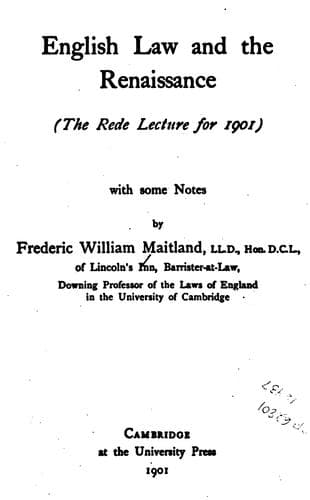
English Law and the Renaissance: The Rede Lecture for 1901Maitland, Frederic William
History
English Law and the Renaissance: The Rede Lecture for 1901
Maitland, Frederic William
Law -- England -- History; Renaissance -- England
[66] Macdonald, _Select Charters_, 1899, p. 1: ‘The first draft of the
charter … was probably drawn by Sir John Popham … but the final form was
the work of Sir Edward Coke, attorney general, and Sir John Dodderidge,
solicitor general.’
[Sidenote: _First Assembly in Virginia._]
[67] Doyle, _The English in America_, vol. I., p. 211: ‘On the 30th of
July, 1619, the first Assembly met in the little church at Jamestown. A
full report of its proceedings still exists in the English Record Office
(_Colonial Papers_, July 30, 1619).’ An abstract is printed in _Calendar
of State Papers, Colonial_, 1574-1660, p. 22.
[Sidenote: _The tenure of Maryland._]
[68] Charter of Maryland, 1632, Macdonald, _Select Charters_, p. 53. In
1620 the grant to the Council of New England (_Ibid._, p. 23) referred
to the manor of East Greenwich and reserved by way of rent a fifth part
of the ore of gold and silver. The grant of Carolina (_Ibid._, p. 121)
reserved a rent of twenty marks and a fourth of the ore. The grant of
New Netherlands to the duke of York (_Ibid._, p. 136) reserved a rent of
forty beaver skins, if demanded. The grant of Pennsylvania to William
Penn speaks of the Castle of Windsor and reserves two beaver skins and
a fifth of the gold and silver ore (_Ibid._, p. 185). Georgia was holden
as of the honour of Hampton Court in the county of Middlesex at a rent of
four shillings for every hundred acres that should be settled (_Ibid._,
p. 242).
[Sidenote: _The tenure of Bombay._]
[69] Charter of 1669 printed among _Charters granted to the East India
Company_ (no date or publisher’s name): ‘to be holden of us, our heirs
and successors as of the manor of East Greenwich in the county of Kent,
in free and common soccage and not in capite nor by knight’s service,
yielding and paying therefor to us, our heirs and successors at the
Custom House, London, the rent or sum of ten pounds of lawful money of
England in gold on the thirtieth day of September yearly for ever.’
[Sidenote: _The tenure of Prince Rupert’s land._]
[70] Charter of 1670 incorporating the Hudson’s Bay Company, printed by
Beckles Wilson, _The Great Company_, vol. II., pp. 318, 327: ‘yielding
and paying yearly to us … two elks and two black beavers, whensoever and
as often as we our heirs and successors shall happen to enter into the
said countries, territories and regions hereby granted.’
[Sidenote: _Kent and Blackstone._]
Public-domain text, read in full here on John Shaqi.
Reviews
Reviews
No reviews yet
Be the first to share your thoughts on this work.
Join the Discussion
Join the discussion
Sign in to leave a comment or review.
Sign InorCreate an account