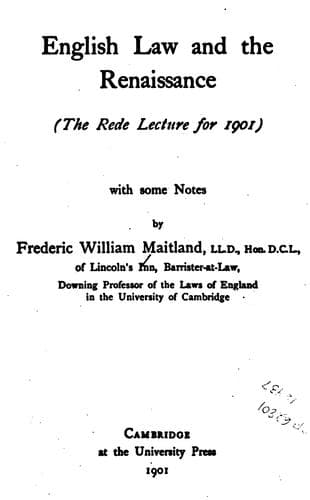
English Law and the Renaissance: The Rede Lecture for 1901Maitland, Frederic William
History
English Law and the Renaissance: The Rede Lecture for 1901
Maitland, Frederic William
Law -- England -- History; Renaissance -- England
[71] Thayer, _The Teaching of English Law at Universities_ in _Harvard
Law Review_, vol. IX., p. 170: ‘“I retired to a country village,”
Chancellor Kent tells us in speaking of the breaking up of Yale College
by the war, where he was a student in 1779, “and, finding Blackstone’s
Commentaries, I read the four volumes.… The work inspired me at the
age of fifteen with awe, and I fondly determined to be a lawyer.” …
“There is abundant evidence,” if we may rely upon the authority of Dr
Hammond, whose language I quote, “of the immediate absorption of nearly
twenty-five hundred copies of the Commentaries in the thirteen colonies
before the Declaration of Independence.”’
[Sidenote: _Marshall and Blackstone._]
[72] Thayer, _John Marshall_, 1901, p. 6: ‘When Marshall was about
eighteen years old he began to study Blackstone.… He seems to have found
a copy of Blackstone in his father’s house.… Just now the first American
edition was out (Philadelphia, 1771-2), in which the list of subscribers,
headed by the name of “John Adams, barrister at law, Boston,” had also
that of “Captain Thomas Marshall, Clerk of Dunmore County.”’
[Sidenote: _Roman law in America._]
[73] It may be interesting to notice that in 1856, and perhaps even
in 1871, Sir H. Maine believed that the Code of Louisiana (‘of all
republications of Roman law the one which appears to us the clearest, the
fullest, the most philosophical and the best adapted to the exigencies
of modern society’) had a grand destiny before it in the United States.
‘Now it is this code, and not the Common Law of England which the newest
American States are taking for the substratum of their laws.… The
Roman law is, therefore, fast becoming the lingua franca of universal
jurisprudence.’ (Maine, _Roman Law and Legal Education_, 1856, reprinted
in _Village Communities_, ed. 3, pp. 360-1.) Nowadays this hope or
fear of a Reception of Roman law in the United States seems, so I am
given to understand, quite unfounded. See e.g. J. F. Dillon, _Laws and
Jurisprudence of England and America_, 1894, p. 155: ‘the common law [in
distinction from the Roman or civil law] is the basis of the laws of
every State and Territory of the Union, with comparatively unimportant
and gradually waning exceptions.’
[Sidenote: _Ihering and the litigious Englishman._]
Public-domain text, read in full here on John Shaqi.
Reviews
Reviews
No reviews yet
Be the first to share your thoughts on this work.
Join the Discussion
Join the discussion
Sign in to leave a comment or review.
Sign InorCreate an account