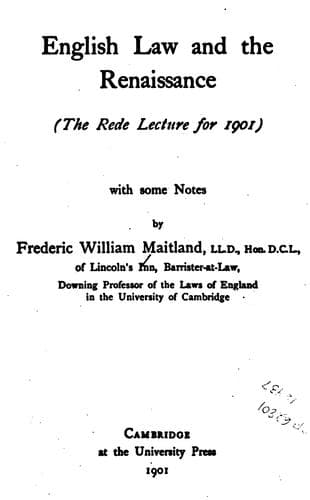
English Law and the Renaissance: The Rede Lecture for 1901Maitland, Frederic William
History
English Law and the Renaissance: The Rede Lecture for 1901
Maitland, Frederic William
Law -- England -- History; Renaissance -- England
he thought badly of Tribonian also, and would have been the last man to
preach a Reception. Professor Alberigo Gentili of Oxford, he too was
protestant enough and could rail at the canonists by the hour; but then
he as an Italian had a bitter feud with the French humanizers, and stood
up for the medieval gloss[30].
Plainly the story is not simple and we must hurry past it. Still the
perplexity of detail should not obscure the broad truth that there was
pleasant reading in the Byzantine Code for a king who wished to be
monarch in church as well as state: pleasanter reading than could be
found in our ancient English law-books. Surely Erastianism is a bad name
for the theory that King Henry approved: Marsilianism seems better, but
Byzantinism seems best[31]. A time had come when, medieval spectacles
being discarded, men could see with the naked eye what stood in the
Code and Novels of Constantinople. In 1558 on the eve of an explosive
Reformation ‘the Protestants of Scotland,’ craving ‘remedy against the
tyranny of the estate ecclesiastical,’ demanded that the controversy
should be judged by the New Testament, the ancient fathers ‘and the
godly approved laws of Justinian the emperor[32].’ University-bred
jurists, even such as came from an oldish school, were very serviceable
to King Henry in the days of the great divorce case and the subsequent
quarrel with the papacy. Tunstall, Gardiner, Bonner, Sampson and Clerk,
to say nothing of the Leghs and Laytons, were doctors of law and took
their fees in bishoprics and deaneries[33]. Certainly they were more
conspicuous and probably they were much abler men than those who were
sitting in the courts of the common law. With the one exception of
Anthony Fitzherbert, the judges of Henry’s reign are not prominent in our
legal history, and we have little reason for attributing deep knowledge
of any sort of law to such chancellors as Audley, Wriothesley and Rich. I
doubt our common lawyers easily accommodated themselves to ecclesiastical
changes. Some years after Elizabeth’s accession the number of barristers
who were known to the government as ‘papists’ was surprisingly large and
it included the great Plowden[34]. But we must go back to our main theme.
Public-domain text, read in full here on John Shaqi.
Reviews
Reviews
No reviews yet
Be the first to share your thoughts on this work.
Join the Discussion
Join the discussion
Sign in to leave a comment or review.
Sign InorCreate an account