English Law and the Renaissance: The Rede Lecture for 1901 — John Shaqi
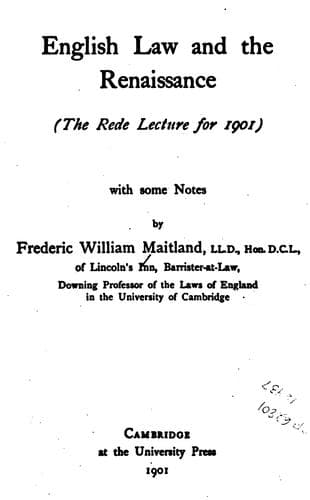
English Law and the Renaissance: The Rede Lecture for 1901Maitland, Frederic William
History
English Law and the Renaissance: The Rede Lecture for 1901
Maitland, Frederic William
Law -- England -- History; Renaissance -- England
A Reception there was not to be, nor dare I say that a Reception was
what our Regius Professor or his royal patron desired. As to Smith
himself, it is fairly evident that some time afterwards, when he had
resigned his chair and was Elizabeth’s ambassador at the French court,
he was well content to contrast the public law of England with that of
‘France, Italy, Spain, Germany and all other countries which’ to use his
words ‘do follow the civil law of the Romans compiled by Justinian into
his Pandects and Code[35].’ The little treatise on the Commonwealth of
England which he wrote at Toulouse in 1565--a remarkable feat for he had
no English books at hand[36]--became a classic in the next century, and
certainly did not underrate those traditional, medieval, Germanic and
parliamentary elements which were still to be found in English life and
law under the fifth and last of the Tudors. Nevertheless I think that a
well-equipped lecturer might persuade a leisurely audience to perceive
that in the second quarter of the sixteenth century the continuity of
English legal history was seriously threatened[37].
Unquestionably our medieval law was open to humanistic attacks. It was
couched partly in bad Latin, partly in worse French. For the business
Latin of the middle age there is much to be said. It is a pleasant
picture that which we have of Thomas More puzzling the omniscient
foreigner by the question ‘An averia carucae capta in withernamio sunt
irreplegibilia[38].’ He asked a practical question in the only Latin in
which that question could have been asked without distortion. Smith’s
acute glance saw that _withernamium_ must have something to do with the
German _wiedernehmen_; for among his other pursuits our professor had
interested himself in the study of English words[39]. But this business
Latin was a pure and elegant language when compared with what served our
lawyers as French. Pole and Smith might well call it barbarous; that it
was fast becoming English was its one redeeming feature. You are likely
to know what I must not call the classical passage: it comes from the
seventeenth century. In all the _Epistolae Obscurorum Virorum_ there is
nothing better than the report which tells how one of Sir Robert Rede’s
successors was assaulted by a prisoner ‘que puis son condemnation ject un
brickbat a le dit justice que narrowly mist[40].’ It is as instructive
as it is surprising that this jargon should have been written in a
country where Frenchmen had long been regarded as hereditary foes. This
prepares us for the remark that taught law is tough law. But when ‘Dunce’
had been set in Bocardo (and it was a doctor of the civil law who set
him there[41]), why should the old law books be spared? They also were
barbarous; they also were sufficiently papistical.
Public-domain text, read in full here on John Shaqi.
Reviews
Reviews
No reviews yet
Be the first to share your thoughts on this work.
Join the Discussion
Join the discussion
Sign in to leave a comment or review.
Sign InorCreate an account