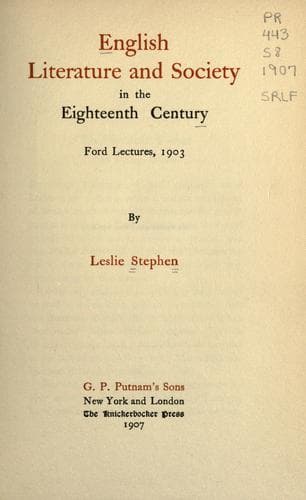
English Literature and Society in the Eighteenth Century — John Shaqi
English Literature and Society in the Eighteenth CenturyStephen, Leslie
History
English Literature and Society in the Eighteenth Century
Stephen, Leslie
England -- Social life and customs -- 18th century; English literature -- 18th century -- History and criticism
Nations, it seems to me, have got on remarkably well, and made not
only material but political and moral progress in the periods when they
have written few books, and those bad ones; and, conversely, have
produced some admirable literature while they were developing some very
ugly tendencies. To say the truth, literature seems to me to be a kind
of by-product. It occupies far too small a part in the whole activity of
a nation, even of its intellectual activity, to serve as a complete
indication of the many forces which are at work, or as an adequate moral
barometer of the general moral state. The attempt to establish such a
condition too closely, seems to me to lead to a good many very edifying
but not the less fallacious conclusions.
The succession of literary species implies that some are always passing
into the stage of 'survivals': and the most obvious course is to
endeavour to associate them with the general philosophical movement.
That suggests one obvious explanation of many literary developments. The
great thriving times of literature have occurred when new intellectual
horizons seemed to be suddenly opening upon the human intelligence; as
when Bacon was taking his Pisgah sight of the promised land of science,
and Shakespeare and Spenser were making new conquests in the world of
the poetic imagination. A great intellectual shock was stimulating the
parallel, though independent, outbursts of activity. The remark may
suggest one reason for the decline as well as for the rise of the new
genus. If, on the one hand, the man of genius is especially sensitive to
the new ideas which are stirring the world, it is also necessary that he
should be in sympathy with his hearers--that he should talk the language
which they understand, and adopt the traditions, conventions, and
symbols with which they are already more or less familiar. A generally
accepted tradition is as essential as the impulse which comes from the
influx of new ideas. But the happy balance which enables the new wine to
be put into the old bottles is precarious and transitory. The new ideas
as they develop may become paralysing to the imagery which they began by
utilising. The legends of chivalry which Spenser turned to account
became ridiculous in the next generation, and the mythology of Milton's
great poem was incredible or revolting to his successors. The machinery,
in the old phrase, of a poet becomes obsolete, though when he used it,
it had vitality enough to be a vehicle for his ideas. The imitative
tendency described by Bagehot clearly tends to preserve the old, as much
as to facilitate the adoption of a new form. In fact, to create a really
original and new form seems to exceed the power of any individual, and
the greatest men must desire to speak to their own contemporaries. It is
only by degrees that the inadequacy of the traditional form makes itself
felt, and its successor has to be worked out by a series of tentative
experiments.
Public-domain text, read in full here on John Shaqi.
Reviews
Reviews
No reviews yet
Be the first to share your thoughts on this work.
Join the Discussion
Join the discussion
Sign in to leave a comment or review.
Sign InorCreate an account