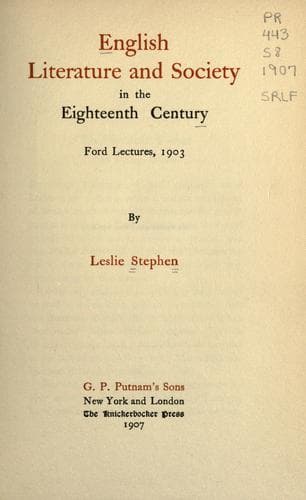
English Literature and Society in the Eighteenth Century — John Shaqi
English Literature and Society in the Eighteenth CenturyStephen, Leslie
History
English Literature and Society in the Eighteenth Century
Stephen, Leslie
England -- Social life and customs -- 18th century; English literature -- 18th century -- History and criticism
power of interpreting the thoughts of his own age, then we can learn
something from studying the social and intellectual position of his
contemporaries. Though the individual remains inexplicable, the general
characteristics of the school to which he belongs may be tolerably
intelligible; and some explanation is in fact suggested by such
epithets, for example, as romantic and classical. For, whatever
precisely they mean,--and I confess to my mind the question of what they
mean is often a very difficult one,--they imply some general tendency
which cannot be attributed to individual influence. When we endeavour to
approach this problem of the rise and fall of literary schools, we see
that it is a case of a phenomenon which is very often noticed and which
we are more ready to explain in proportion to the share of youthful
audacity which we are fortunate enough to possess.
In every form of artistic production, in painting and architecture, for
example, schools arise; each of which seems to embody some kind of
principle, and develops and afterwards decays, according to some
mysterious law. It may resemble the animal species which is, somehow or
other, developed and then stamped out in the struggle of existence by
the growth of a form more appropriate to the new order. The epic poem,
shall we say? is like the 'monstrous efts,' as Tennyson unkindly calls
them, which were no doubt very estimable creatures in their day, but
have somehow been unable to adapt themselves to recent geological
epochs. Why men could build cathedrals in the Middle Ages, and why their
power was lost instead of steadily developing like the art of
engineering, is a problem which has occupied many writers, and of which
I shall not attempt to offer a solution. That is the difference between
artistic and scientific progress. A truth once discovered remains true
and may form the nucleus of an independently interesting body of truths.
But a special form of art flourishes only during a limited period, and
when it decays and is succeeded by others, we cannot say that there is
necessarily progress, only that for some reason or other the environment
has become uncongenial. It is, of course, tempting to infer from the
decay of an art that there must be a corresponding decay in the vitality
and morality of the race. Ruskin, for example, always assumed in his
most brilliant and incisive, but not very conclusive, arguments that men
ceased to paint good pictures simply because they ceased to be good men.
He did not proceed to prove that the moral decline really took place,
and still less to show why it took place. But, without attacking these
large problems, I shall be content to say that I do not see that any
such sweeping conclusions can be made as to the kind of changes in
literary forms with which we shall be concerned. That there is a close
relation between the literature and the general social condition of a
nation is my own contention. But the relation is hardly of this simple
kind.
Public-domain text, read in full here on John Shaqi.
Reviews
Reviews
No reviews yet
Be the first to share your thoughts on this work.
Join the Discussion
Join the discussion
Sign in to leave a comment or review.
Sign InorCreate an account