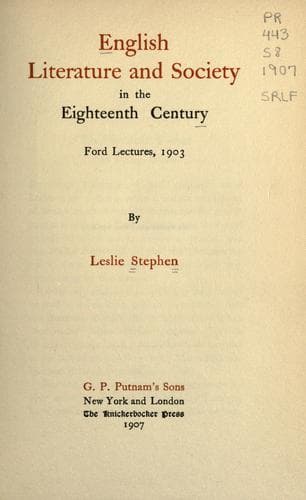
English Literature and Society in the Eighteenth CenturyStephen, Leslie
History
English Literature and Society in the Eighteenth Century
Stephen, Leslie
England -- Social life and customs -- 18th century; English literature -- 18th century -- History and criticism
I hope and believe that I have said nothing original. I have certainly
only been attempting to express the views which are accepted, in their
general outline at least, by historians, whether of the political or
literary kind. They have often been applied very forcibly to the various
literary developments, and, by way of preface to my own special topic, I
will venture to recall one chapter of literary history which may serve
to illustrate what I have already said, and which has a bearing upon
what I shall have to say hereafter.
One of the topics upon which the newer methods of criticism first
displayed their power was the school of the Elizabethan dramatists. Many
of the earlier critics wrote like lovers or enthusiasts who exalted the
merits of some of the old playwrights beyond our sober judgments, and
were inclined to ignore the merits of other forms of the art. But we
have come to recognise that the Elizabethans had their faults, and that
the best apology for their weaknesses as well as the best explanation of
their merits was to be found in a clearer appreciation of the whole
conditions. It is impossible of course to overlook the connection
between that great outburst of literary activity and the general
movement of the time; of the period when many impulses were breaking up
the old intellectual stagnation, and when the national spirit which took
the great Queen for its representative was finding leaders in the
Burleighs and Raleighs and Drakes. The connection is emphasised by the
singular brevity of the literary efflorescence. Marlowe's _Tamburlaine_
heralded its approach on the eve of the Spanish Armada: Shakespeare, to
whom the lead speedily fell, had shown his highest power in _Henry IV._
and _Hamlet_ before the accession of James I.: his great tragedies
_Othello_, _Macbeth_ and _Lear_ were produced in the next two or three
years; and by that time, Ben Jonson had done his best work. When
Shakespeare retired in 1611, Chapman and Webster, two of the most
brilliant of his rivals, had also done their best; and Fletcher
inherited the dramatic throne. On his death in 1625, Massinger and Ford
and other minor luminaries were still at work; but the great period had
passed. It had begun with the repulse of the Armada and culminated some
fifteen years later. If in some minor respects there may afterwards have
been an advance, the spontaneous vigour had declined and deliberate
attempts to be striking had taken the place of the old audacity. There
can be no more remarkable instance of a curious phenomenon, of a
volcanic outburst of literary energy which begins and reaches its
highest intensity while a man is passing from youth to middle age, and
then begins to decay and exhaust itself within a generation.
Public-domain text, read in full here on John Shaqi.
Reviews
Reviews
No reviews yet
Be the first to share your thoughts on this work.
Join the Discussion
Join the discussion
Sign in to leave a comment or review.
Sign InorCreate an account