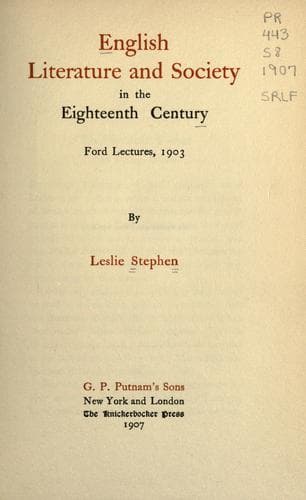
English Literature and Society in the Eighteenth CenturyStephen, Leslie
History
English Literature and Society in the Eighteenth Century
Stephen, Leslie
England -- Social life and customs -- 18th century; English literature -- 18th century -- History and criticism
A popular view used to throw the responsibility upon the wicked Puritans
who used their power to close the theatres. We entered the
'prison-house' of Puritanism says Matthew Arnold, I think, and stayed
there for a couple of centuries. If so, the gaolers must have had some
difficulty, for the Puritan (in the narrower sense, of course) has
always been in a small and unpopular minority. But it is also plain
that the decay had begun when the Puritan was the victim instead of the
inflictor of persecution. When we note the synchronism between the
political and the literary movement our conception of the true nature of
the change has to be modified. The accession of James marks the time at
which the struggle between the court and the popular party was beginning
to develop itself: when the monarchy and its adherents cease to
represent the strongest current of national feeling, and the bulk of the
most vigorous and progressive classes have become alienated and are
developing the conditions and passions which produced the civil war. The
genuine Puritans are still an exception; they only form the left wing,
the most thorough-going opponents of the court-policy; and their triumph
afterwards is only due to the causes which in a revolution give the
advantage to the uncompromising partisans, though their special creed is
always regarded with aversion by a majority. But for the time, they are
the van of the party which, for whatever reason, is gathering strength
and embodying the main political and ecclesiastical impulses of the
time. The stage, again, had been from the first essentially
aristocratic: it depended upon the court and the nobility and their
adherents, and was hostile both to the Puritans and to the whole class
in which the Puritan found a congenial element. So long, as in
Elizabeth's time, as the class which supported the stage also
represented the strongest aspirations of the period, and a marked
national sentiment, the drama could embody a marked national sentiment.
When the unity was broken up and the court is opposed to the strongest
current of political sentiment, the players still adhere to their
patron. The drama comes to represent a tone of thought, a social
stratum, which, instead of leading, is getting more and more opposed to
the great bulk of the most vigorous elements of the society. The stage
is ceasing to be a truly national organ, and begins to suit itself to
the tastes of the unprincipled and servile courtiers, who, if they are
not more immoral than their predecessors, are without the old heroic
touch which ennobled even the audacious and unscrupulous adventurers of
the Armada period. That is to say, the change is beginning which became
palpable in the Restoration time, when the stage became simply the
melancholy dependent upon the court of Charles II., and faithfully
reflected the peculiar morality of the small circle over which it
presided. Without taking into account this process by which the organ of
Public-domain text, read in full here on John Shaqi.
Reviews
Reviews
No reviews yet
Be the first to share your thoughts on this work.
Join the Discussion
Join the discussion
Sign in to leave a comment or review.
Sign InorCreate an account