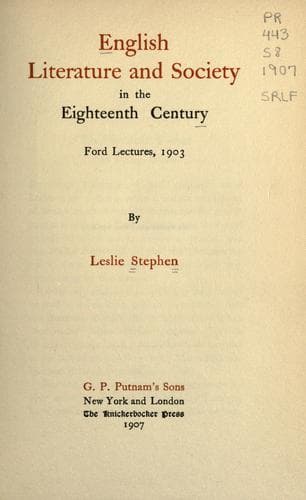
English Literature and Society in the Eighteenth CenturyStephen, Leslie
History
English Literature and Society in the Eighteenth Century
Stephen, Leslie
England -- Social life and customs -- 18th century; English literature -- 18th century -- History and criticism
The first period of which I am to speak represents to the political
historian the Avatar of Whiggism. The glorious revolution has decided
the long struggle of the previous century; the main outlines of the
British Constitution are irrevocably determined; the political system is
in harmony with the great political forces, and the nation has settled,
as Carlyle is fond of saying, with the centre of gravity lowest, and
therefore in a position of stable equilibrium. For another century no
organic change was attempted or desired. Parliament has become
definitely the great driving-wheel of the political machinery; not, as a
century before, an intrusive body acting spasmodically and hampering
instead of regulating the executive power of the Crown. The last Stuart
kings had still fancied that it might be reduced to impotence, and the
illusion had been fostered by the loyalty which meant at least a fair
unequivocal desire to hold to the old monarchical traditions. But, in
fact, parliamentary control had been silently developing; the House of
Commons had been getting the power of the purse more distinctly into its
hands, and had taken very good care not to trust the Crown with the
power of the sword. Charles II. had been forced to depend on the help of
the great French monarchy to maintain his authority at home; and when
his successor turned out to be an anachronism, and found that the
loyalty of the nation would not bear the strain of a policy hostile to
the strongest national impulses, he was thrown off as an intolerable
incubus. The system which had been growing up beneath the surface was
now definitely put into shape and its fundamental principles embodied in
legislation. The one thing still needed was to work out the system of
party government, which meant that parliament should become an organised
body with a corporate body, which the ministers of the Crown had first
to consult and then to obey. The essential parts of the system had, in
fact, been established by the end of Queen Anne's reign; though the
change which had taken place in the system was not fully recognised
because marked by the retention of the old forms. This, broadly
speaking, meant the supremacy of the class which really controlled
Parliament: of the aristocratic class, led by the peers but including
the body of squires and landed gentlemen, and including also a growing
infusion of 'moneyed' men, who represented the rising commercial and
manufacturing interests. The division between Whig and Tory corresponded
mainly to the division between the men who inclined mainly to the Church
and squirearchy and those who inclined towards the mercantile and the
dissenting interests. If the Tory professed zeal for the monarchy, he
did not mean a monarchy as opposed to Parliament and therefore to his
own dearest privileges. Even the Jacobite movement was in great part
personal, or meant dislike to Hanover with no preference for arbitrary
Public-domain text, read in full here on John Shaqi.
Reviews
Reviews
No reviews yet
Be the first to share your thoughts on this work.
Join the Discussion
Join the discussion
Sign in to leave a comment or review.
Sign InorCreate an account